Solar EV Charging Carshare programs are revolutionizing commercial real estate energy strategies by eliminating expensive utility interconnections, bypassing civil engineering delays, and mitigating long-term demand charges across urban multi-family properties, municipal developments, and public transit hubs…
Disclaimer: This post contains affiliate links. If you click through and make a purchase or submit a request for a quote, we may earn a small commission or referral fee at no extra cost to you.
Table of Contents
Solar EV Charging Carshare Infrastructure Protects Commercial CapEx
Commercial property developers and municipal planners face severe financial risk when deploying traditional grid-connected vehicle charging stations in dense urban environments.
Utility interconnection delays often push project completion timelines back by 12 to 18 months while consuming capital through civil trenching, asphalt destruction, and electrical panel upgrades.
Deploying off-grid solar EV charging canopy platforms bypasses these multi-million-dollar grid constraints entirely by generating and storing zero-cost renewable electricity directly on-site.
The recent launch of the CommunityEV Carshare pilot program across Greater Boston illustrates how off-grid generation protects building envelopes and capital allocations.
Initiated by the Metropolitan Area Planning Council in partnership with Zipcar, the pilot utilizes $1,000,000 in grant funding from the Massachusetts Clean Energy Center to station electric vehicles at public housing developments in Boston, Chelsea, Framingham, and Quincy.
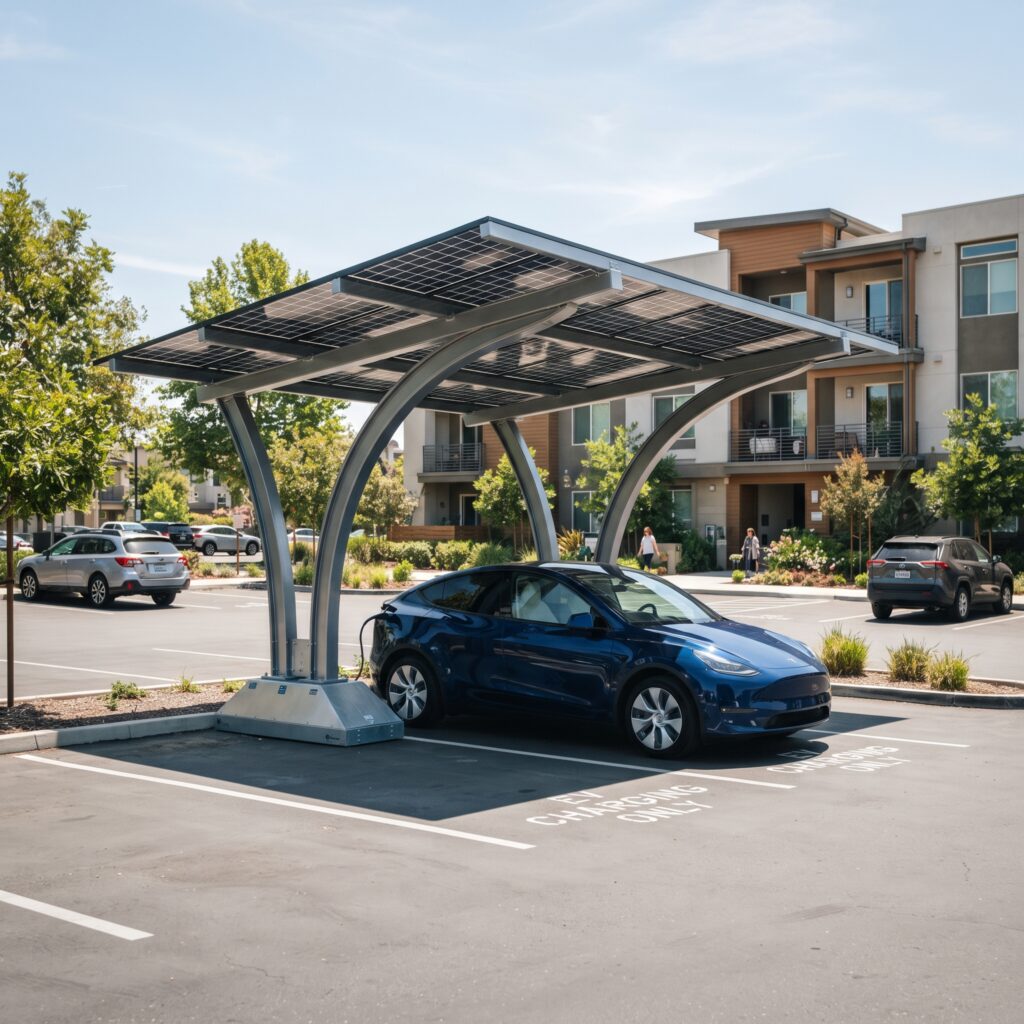
To bypass prohibitive utility interconnection costs and site disruption, the initiative deployed standalone off-grid solar EV charging canopy units engineered by Beam Global.
These transportable solar structures fit within the footprint of a standard parking bay, requiring zero concrete pad construction or underground conduit trenching.
Property engineers benefit from zero disruption to existing pavement, preventing water intrusion risks beneath asphalt parking lots and avoiding structural degradation around building foundations.
By eliminating physical utility hookups, commercial real estate owners remove the exposure to escalating utility demand charges that typically accompany multi-vehicle charging sessions.
Each standalone unit generates sufficient solar electricity on-site to deliver up to 265 e-miles of driving range per day while supporting dual simultaneous Level 2 charging sessions.
Integrated battery storage banks inside the canopy base ensure continuous power delivery overnight and during extreme atmospheric weather events.
Commercial facility managers protect their primary service panels from thermal overloads because the charging apparatus remains completely isolated from the primary building circuit.
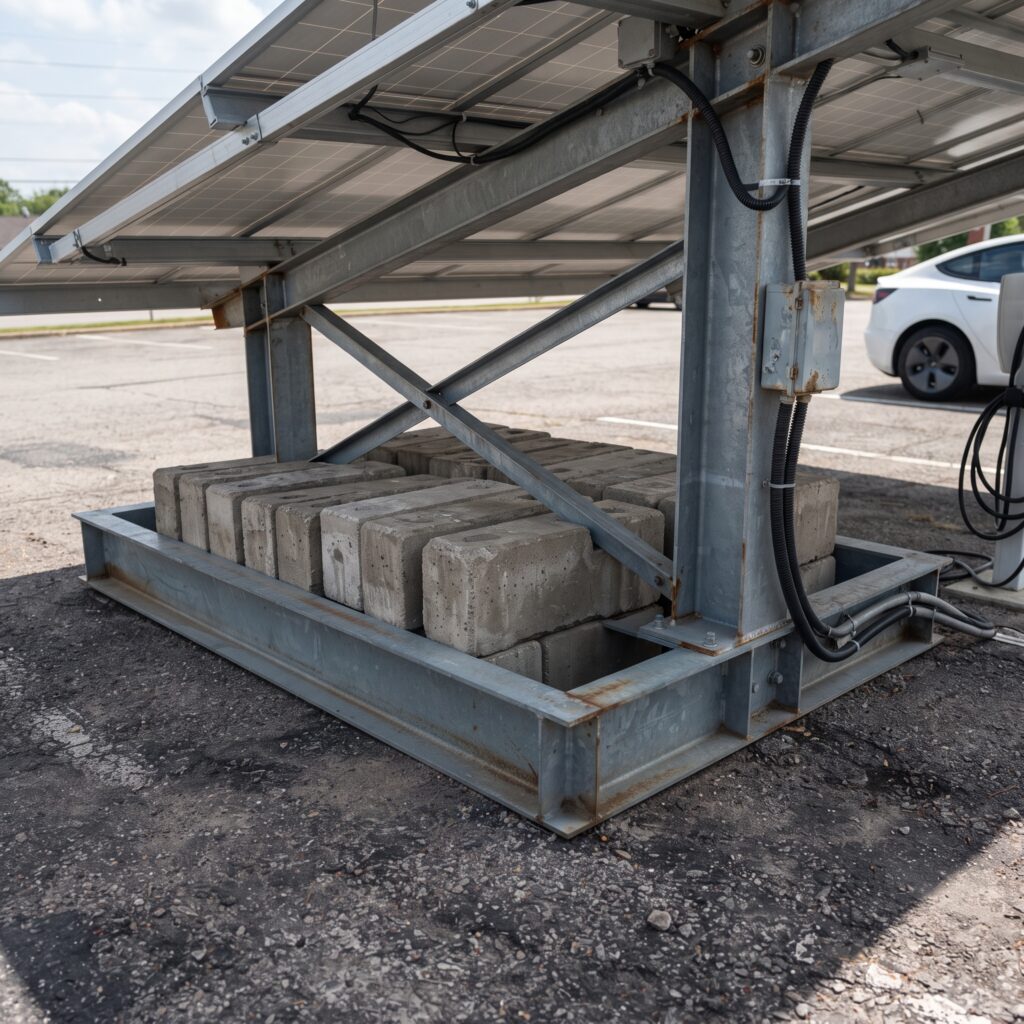
In terms of physical structural standards, these self-ballasted solar canopies are rated to withstand sustained wind velocities up to 160 mph without requiring ground anchor bolting.
The heavy structural base utilizes gravity-fit engineering to anchor the unit, providing emergency islanding power to commercial facilities during municipal blackout events.
📋 Commercial Property & Fleet Notice:
Prevent costly civil engineering delays and eliminate utility demand charges on your next multi-family or commercial
development by booking a comprehensive off-grid solar EV site assessment today.
Commercial Fleet Electrification Consultation Mitigates Long-Term OpEx
Integrating an off-grid solar EV charging canopy within multi-family residential developments dramatically alters the Total Cost of Ownership profile for site operators and fleet managers.
Standard grid-tied commercial charging setups trigger recurring monthly capacity fees and utility ratchet charges when multiple vehicles charge simultaneously during peak power hours.
Requesting a formal commercial EV electrification consultation allows property owners to model how solar-assisted load shedding shields facility operating budgets from utility rate volatility.
By leveraging off-grid solar capture, site hosts eliminate the zero-unit energy costs entirely, generating clean fuel that never appears on a utility invoice.
This absolute operating cost isolation allows carshare platforms like Zipcar to lower annual membership fees from $90 down to $35 while maintaining discounted hourly rental rates of $11 on weekdays for lower-income drivers.
For fleet operators managing shared assets, avoiding utility demand spikes ensures that vehicle operational expenses remain fixed and predictable year after year.
From an equipment longevity perspective, removing high-draw vehicle charging loads from aging building transformers prevents premature core overheating and costly transformer replacement cycles.
Facility maintenance teams also avoid the ongoing labor expense of managing submetering hardware or negotiating complex utility re-billing agreements across commercial tenant bases.
Deploying transportable off-grid hardware preserves capital flexibility, allowing property owners to relocate the entire charging asset if site parking layouts are reconfigured in the future.
If a commercial lease expires or a property changes ownership, the solar canopy unit can be re-loaded onto a transport trailer and redeployed at another location within hours.
Commercial real estate portfolios that adopt modular off-grid infrastructure maintain higher flexibility, lower capital risk, and immediate compliance with municipal building decarbonization mandates.
Conclusion
Understanding the structural and financial benefits of off-grid solar EV charging infrastructure empowers commercial property managers, housing authorities, and fleet operators to expand clean mobility without grid delays.
Deploying modular, wind-rated solar canopies bypasses expensive utility upgrades, shields facility operating budgets from peak demand penalties, and preserves structural building envelopes.
Commercial stakeholders who embrace rapid-deployment solar charging assets position their properties for long-term operational resilience, higher asset valuation, and immediate decarbonization compliance.