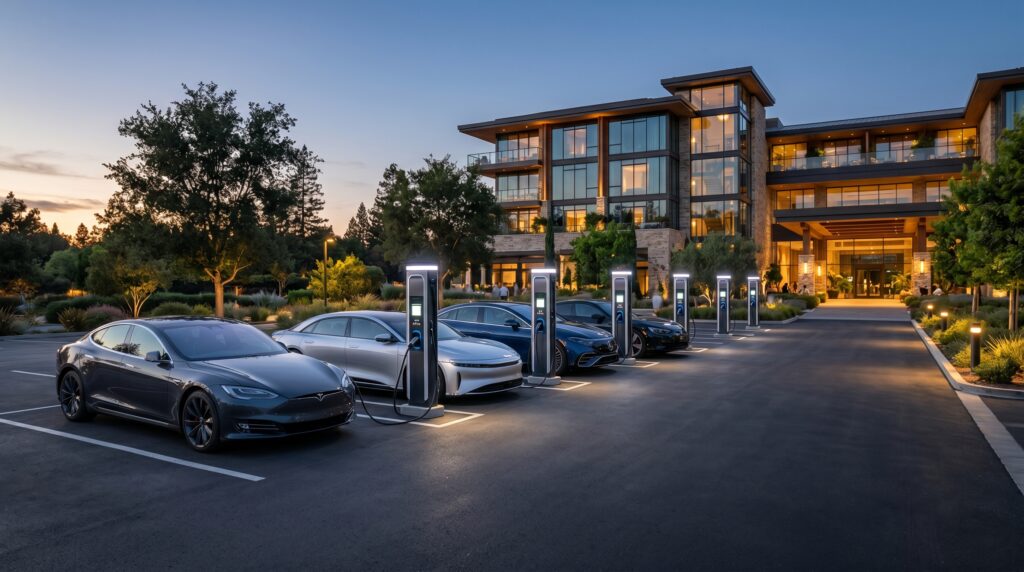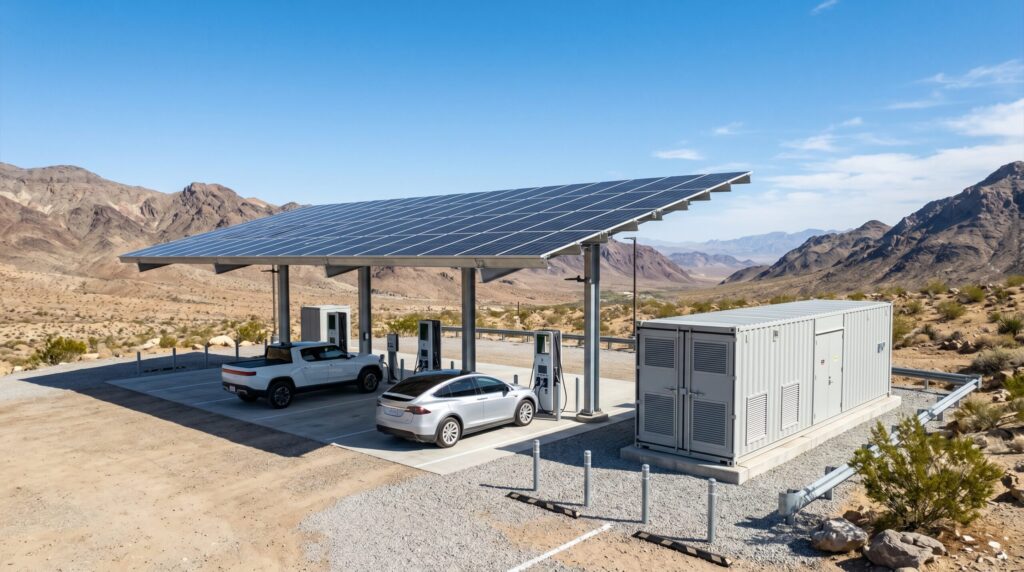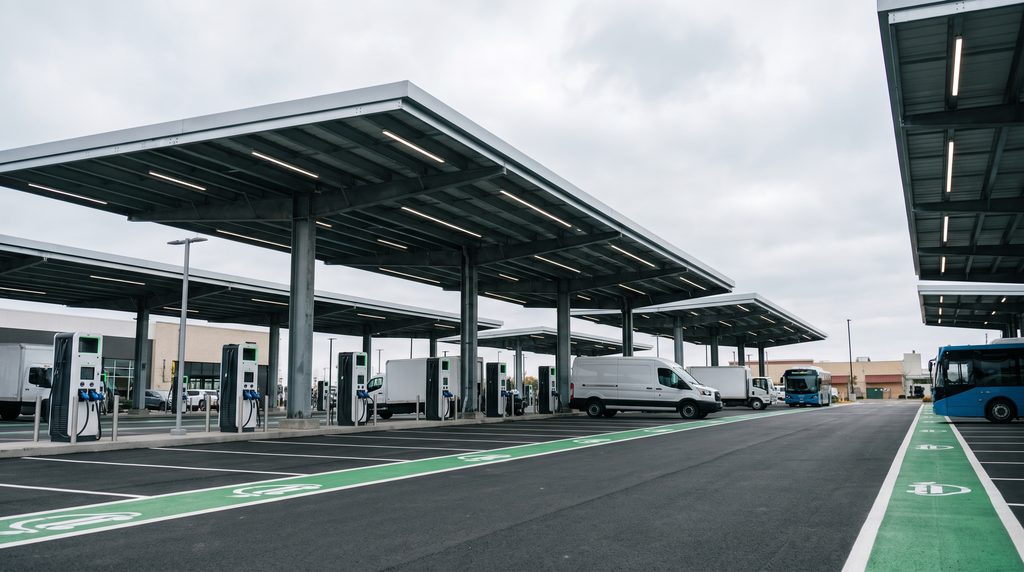
Public charger durability dictates whether commercial property developers generate reliable recurring revenue or drown in unexpected maintenance expenditures. High-volume fast-charging plazas face severe grid connection hurdles, harsh winter weather cycles, heavy cable wear, and punishing equipment utilization that threaten long-term capital investments…
Disclaimer: This post contains affiliate links. If you click through and make a purchase or submit a request for a quote, we may earn a small commission or referral fee at no extra cost to you.
Table of Contents
Public Charger Durability Requires Engineered Enclosures and Site Protection
Public charger durability directly determines whether high-throughput commercial charging plazas stay operational or suffer from chronic equipment downtime.
High-power DC fast-charging plazas must survive heavy public handling, vehicular vibrations, driving rain, and sub-zero freeze-thaw cycles without breaking down.
The recent opening of EVgo’s flagship charging station at a Meijer retail location in Warren, Michigan—right across from General Motors’ Global Technical Center—illustrates this commercial infrastructure shift.
Featuring 12 high-power charging stalls capable of delivering up to 350 kW each, the site incorporates both Combined Charging System and North American Charging Standard connectors to serve all modern electric vehicles.
High-capacity hubs delivering hundreds of kilowatts per stall generate immense electrical and thermal stress inside offboard power electronics.
When commercial developers choose bargain-tier hardware housings, water ingress and internal thermal expansion quickly ruin expensive power conversion components.
Commercial developers who fail to install rugged physical site protections risk voiding manufacturer warranties after routine parking scrapes or accidental cable tugs.
Every charging island requires heavy structural steel bollards anchored into deep concrete footings to shield expensive high-voltage dispensers from vehicle impacts.
Engineers must also specify heavy-gauge NEMA 4 or NEMA 3R stainless steel enclosures to prevent salt air, road grime, and humidity from corroding sensitive circuit boards.
Depot planners frequently enclose primary switchgear rooms in durable materials like structural insulated panels to ensure climate control and precision engineering around sensitive power electronics.
These structural insulated panels, known as SIPs, isolate high-voltage power conversion equipment from extreme outside ambient temperatures and driving rain.
Enclosure designs must also achieve certified wind-velocity ratings to withstand severe coastal storms and harsh industrial yard environments without losing structural integrity.
Proper physical enclosures safeguard multi-million-dollar capital investments against routine physical impacts, environmental dust, and corrosive moisture.
Failing to harden the building envelope around switchgear installations voids manufacturer warranties and raises commercial property insurance premiums.
High-traffic urban retail hubs face relentless daily mechanical wear from hundreds of consecutive plug-in cycles.
Heavy liquid-cooled charging cables dragging across rough asphalt quickly wear through outer protective sleeves and rupture vital internal cooling loops.
Commercial operators must install overhead cable retractor gantries to balance the physical weight of 500-amp cords and keep connectors off the wet ground.
Damaged connector pins or cracked plug housings introduce high-resistance contact points that cause chargers to throttle power output or throw critical safety ground faults.
When charging stalls sit broken, commercial site hosts lose out on dwell-time retail foot traffic and suffer direct transaction revenue losses.
Unplanned equipment outages also leave host properties vulnerable to severe uptime penalties under municipal or federal infrastructure grant agreements.
Routine mechanical wear compounds exponentially during freezing winter conditions when stiffened charging cables crack under manual bending force.
Investing in heavy-duty commercial dispensers with integrated internal heaters preserves cable flexibility and maintains steady power delivery during severe winter freezes.
Structural Standards and Wind-Velocity Ratings
Large public charging destinations increasingly require full-coverage overhead steel canopies to protect visiting drivers and sensitive electronics from extreme weather.
Civil engineers must design these overhead canopy structures to satisfy rigorous local structural standards and strict regional building codes.
In northern industrial corridors, overhead canopies must handle substantial snow load capacities exceeding 40 pounds per square foot to prevent catastrophic roof sagging.
These engineered steel canopy frameworks must also carry certified wind-velocity ratings capable of withstanding severe gusts reaching 115 miles per hour.
Deploying certified canopy structures protects multi-million-dollar dispenser assets and minimizes property liability risks for commercial parking lot owners.
Canopy framing also provides an ideal mounting platform for high-output overhead LED floodlights and panoramic security surveillance cameras.
Adequate site illumination prevents nighttime vandalism, discourages copper cable theft, and fosters a secure charging environment for retail shoppers.
Integrating automated drainage channels into canopy roofs diverts rainwater away from pedestrian pathways and prevents hazardous ice sheets from forming across charging aprons.
📋 Commercial Property & Fleet Notice: Avoid unbudgeted utility peak penalties, interconnection bottlenecks, and premature hardware wear by scheduling an engineered commercial site assessment, equipment quote review, and CapEx recovery audit for your facility today.
Modular Power Cabinet Configurations Protect Upfront Capital Investments
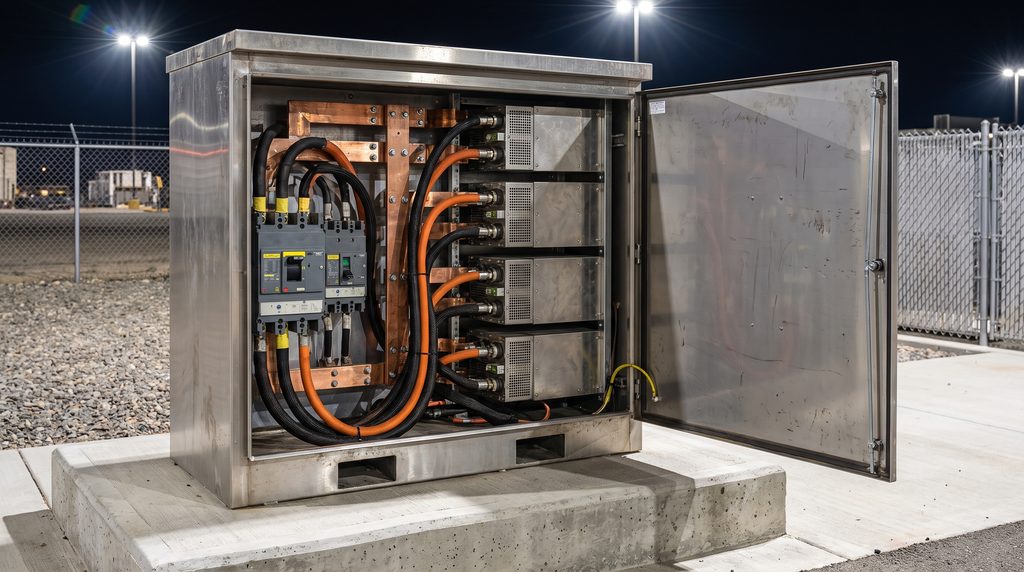
Modern high-power fast-charging architecture relies heavily on a centralized modular power cabinet layout rather than standalone all-in-one dispenser towers.
A modular power cabinet layout separates the massive power conversion electronics from the compact customer-facing charging dispensers.
Placing the high-voltage rectification modules into a shared, climate-controlled modular power cabinet allows operators to service hardware safely away from public parking stalls.
This architectural separation protects valuable power electronics from accidental physical collisions and minimizes the footprint required in busy commercial retail lots.
A modular power cabinet configuration also enables dynamic power routing between active charging stalls based on real-time vehicle power demands.
When a connected vehicle slows its charging rate at a higher battery state of charge, the system shifts idle power modules to adjacent vehicles needing maximum energy.
Dynamic power sharing maximizes station energy throughput and shortens driver wait times without requiring an oversized utility service drop.
Operators can gradually increase site capacity by sliding additional power conversion cards into an existing modular power cabinet as regional EV traffic expands.
This phased expansion strategy saves commercial property owners hundreds of thousands of dollars in early civil engineering and trenching work.
Field technicians can hot-swap a single faulted power module inside a modular power cabinet in minutes while keeping all remaining charging stalls fully energized.
Eliminating complete station shutdowns protects ongoing cash flow and preserves customer confidence in public charging network reliability.
Navigating Grid Timelines Through a Fleet Electrification Consultation
Securing sufficient grid power for multi-megawatt commercial charging hubs requires intense upfront planning and strict electrical utility coordination.
A single plaza supporting twelve 350-kW fast chargers can demand an instant electrical grid draw exceeding 4,000 kilovolt-amperes.
Securing that volume of electrical capacity from regional utility providers often involves complex grid impact studies that take 12 to 18 months to finalize.
Engaging in an early fleet electrification consultation allows site developers to map out utility transformer lead times before spending capital on site construction.
Experienced engineering advisors audit available substation feeder capacity and help developers reserve power before adjacent commercial projects exhaust the local circuit.
Waiting until civil construction begins to negotiate transformer delivery guarantees multi-month delays that leave expensive charging hardware sitting idle on site.
A comprehensive fleet electrification consultation models daily peak demand charges to prevent shocking utility penalties that destroy operational margins.
Unmanaged electrical demand spikes can generate utility peak penalties exceeding $30,000 per month on high-capacity commercial charging accounts.
Site developers can mitigate these crushing demand charges by installing stationary commercial battery storage systems alongside primary switchgear.
On-site battery arrays charge during low-cost utility windows and discharge surplus power into vehicles during peak daytime charging surges.
Coupling commercial battery storage with parking canopy solar arrays allows site operators to generate clean power on site and lower their total cost of energy.
Microgrid controllers automatically coordinate power distribution between the regional grid, stationary battery banks, solar arrays, and connected vehicles.
This integrated microgrid setup ensures uninterrupted charging service even during localized utility power outages and brownouts.
Preventative Maintenance Schedules and Operating Expense Control
Maintaining high asset uptime across public charging networks requires aggressive preventative maintenance schedules backed by real-time remote diagnostics.
Field technicians must conduct detailed visual and physical inspections of every charging dispenser at least once per month.
Technicians must test safety break-away couplings, inspect cable jacket integrity, and clean debris from internal air filtration screens during every scheduled site visit.
Annual maintenance procedures must incorporate infrared thermography scans across all electrical switchboards, disconnect switches, and transformer junctions.
Infrared scans detect high-resistance electrical hot spots caused by loose busbar bolts before they cause catastrophic equipment fires or arc flash failures.
Operators must also test ground-fault detection circuits and verify accurate current-limiting calibrations on liquid-cooled cable power modules.
Remote telemetry gateways continuously transmit internal temperature readings, fan speeds, and insulation resistance data back to central network operations centers.
Automated algorithmic monitoring detects abnormal thermal spikes inside cable handles and schedules proactive field repairs before parts fail completely.
Keeping complete, auditable maintenance records is critical for preserving equipment warranty coverage with primary hardware manufacturers.
Insurance carriers frequently demand documented proof of certified preventative maintenance before approving property loss claims following electrical equipment failures.
Rigorous maintenance practices protect multi-million-dollar capital investments and preserve long-term asset value for commercial real estate owners.
Conclusion
Maximizing public charger durability across commercial vehicle hubs requires a balanced strategy of hardened physical site design, modular electrical architecture, and relentless preventive maintenance.
Deploying scalable power cabinets, protective canopies, and automated cable management protects multi-million-dollar capital expenditures against premature failure and costly downtime.
Commercial property owners who secure early utility capacity, model peak demand charges, and integrate resilient microgrid assets lock in reliable operational margins.
Prioritizing robust engineering standards and public charger durability ensures that your commercial charging destination remains a profitable asset for decades to come.