Disclaimer: This post contains affiliate links. If you click through and make a purchase or submit a request for a quote, we may earn a small commission or referral fee at no extra cost to you. This helps support our independent hardware testing and industrial energy research.
Table of Contents
Electric vehicles are completely changing the way commercial fleet operators and property managers think about basic transit logistics.
Many business owners want to add fast charging ports but they run into massive roadblocks with the local utility power grid.
Getting new electrical lines approved can take months or even several years of waiting for local permits.
An elegant solution to this problem is using an off-grid solar EV charging system to bypass the utility company completely.
This technical guide breaks down how self-contained solar microgrids allow companies to install reliable vehicle chargers in a single afternoon.
The Reality of Off-Grid Commercial EV Charging
Operating an independent power hub means your business generates every single kilowatt-hour of juice directly from sunshine.
For fleet logistics hubs and remote commercial properties, this setup brings instant energy independence and eliminates monthly electricity bills.
Standard workplace chargers put a major strain on corporate energy budgets because they draw massive amounts of current all at once.
When multiple trucks or employee cars plug in at the exact same time, the utility company hits the business with expensive peak-demand charges.
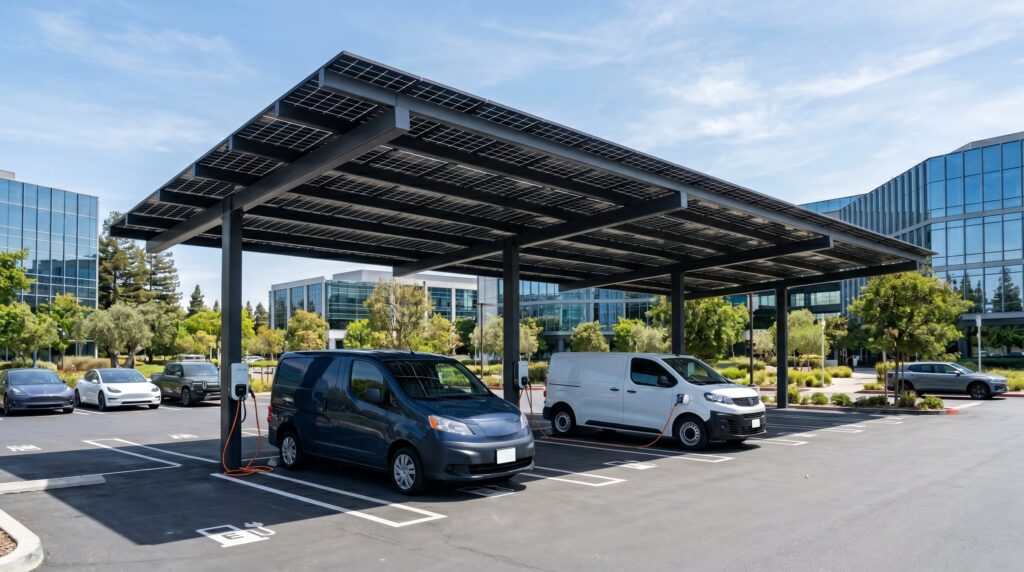
By deploying an isolated solar canopy, you create a dedicated fueling zone that keeps vehicle charging costs completely separate from the main building power meter.
This isolated layout protects your primary facility from local blackouts, grid failures, and unexpected seasonal power surges.
Investing in off-grid hardware also helps companies achieve corporate sustainability goals while modernizing their parking lots with eco-friendly business modifications.
How Pop-Up Solar Canopies Solve the Two-Year Transformer Wait
The traditional process for installing commercial car chargers requires massive trenching, deep excavation, and expensive structural permits.
In many industrial zones, the wait time to receive a new electrical transformer from the utility company is now two years or longer.
Hardware manufacturers have solved this operational bottleneck by engineering rapid-deployment transportable carports like the patented Paired Power PairTree system.
This modular system features a clever integrated lift mechanism that allows workers to assemble the entire frame safely at ground level.
Once the solar panels are securely fastened, the mechanism lifts the canopy into place without needing heavy cranes or scaffolding.
A two-person crew can complete the mechanical setup in less than four hours using standard hand tools.
Because these units sit on the asphalt without deep concrete footings, local building departments view them as temporary structures.
This classification allows commercial property owners to completely skip the lengthy zoning reviews that delay standard construction projects.
Inside the Hardware: Bifacial Panels and Heavy-Duty Battery Storage
The core energy collection engine relies on a 4.6 kW to 5 kW solar canopy equipped with advanced bifacial solar modules.
Traditional single-sided solar panels only capture direct light from the sky above.
Bifacial modules have glass on both sides, allowing them to absorb reflected light bouncing off the concrete or asphalt parking surface below.
This dual-sided absorption design boosts the overall energy yield by up to 15% compared to basic roof-mounted arrays.
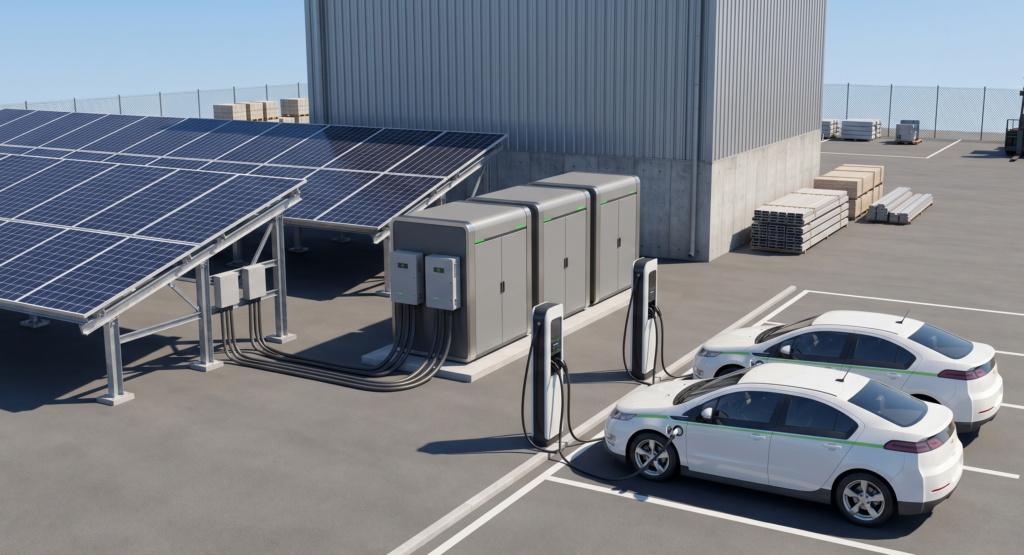
The captured energy flows directly into a heavy-duty Battery Energy Storage System (BESS) featuring a substantial 42.4 kWh capacity.
Storing this power is necessary because it allows the system to deliver stable Level 2 charging day or night.
The system outputs up to 5.3 kW of continuous electrical power through standard universal SAE J1772 charging interfaces.
Depending on the specific car model, this standalone setup reliably delivers between 75 and 230 miles of daily driving range.
The True Cost of Setup vs. Long-Term Utility Savings
Purchasing an industrial off-grid solar EV charging system requires a clear understanding of up-front hardware costs versus operational payback.
A standalone PairTree system has a starting equipment price of approximately $26,000.
Adding maximum battery capacity modules and multiple dual-port chargers can bring the total hardware investment to over $70,000.
Professional delivery and onsite assembly add an average of $5,000 to the initial project invoice.
However, commercial buyers can drastically reduce this cost by utilizing the federal Inflation Reduction Act (IRA) to claim a 40% tax credit.
When you factor in the total elimination of utility connection fees, trenching costs, and monthly demand charges, the return on investment happens much faster.
💡 Pro Tip: When evaluating your site budget, always calculate the hidden costs of operational disruption. Traditional grid-tied charger installation can shut down your commercial parking lot for weeks due to trenching, whereas a pop-up microgrid keeps your yard fully operational during its four-hour setup.
Preventative Maintenance and Weatherproofing for Commercial Microgrids
Commercial outdoor hardware faces severe wear-and-tear from shifting seasonal weather and constant daily use by drivers.
Traditional solar carports often use mechanical tracking motors to turn the panels toward the sun throughout the day.
While tracking sounds good on paper, those moving parts often jam, freeze, or suffer from expensive electronic component failures over time.
To maximize fleet uptime, these pop-up canopies utilize a rigid fixed-tilt structural design with zero moving parts.
Eliminating motors allows the system to achieve an impressive 99.7% operational uptime rating with almost zero annual maintenance.
The underlying structural steel frame is engineered to withstand extreme environment threats, including 40 pounds per square foot snow loads.
The heavy ballast foundation is also aerodynamically rated to handle intense wind speeds of up to 130 miles per hour.
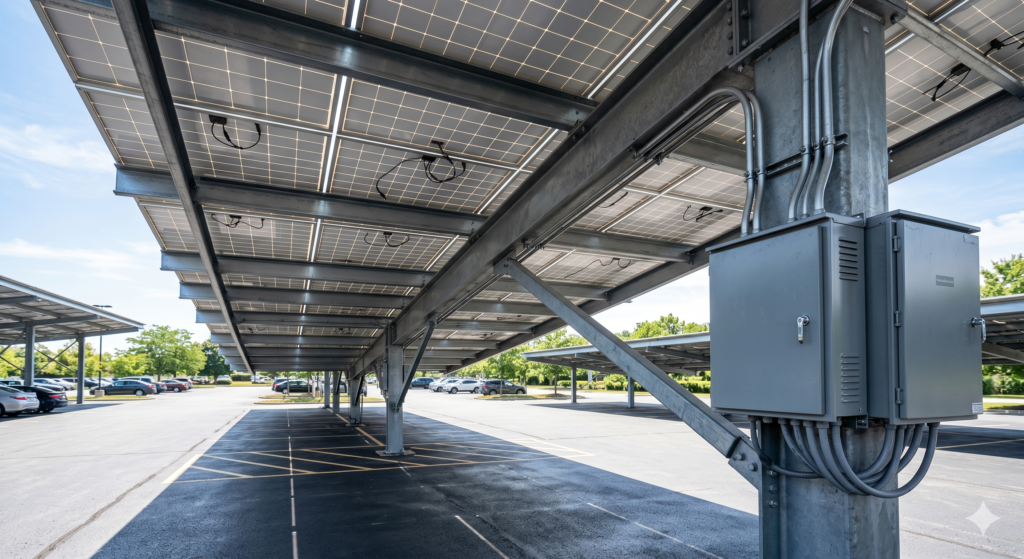
The internal charge controllers and power inverters are housed inside a weather-sealed enclosure that operates smoothly from -6.6°C up to 48.8°C.
Property managers can easily monitor energy production, battery state-of-charge, and charger health remotely through an encrypted cloud smartphone app.
💡 Pro Tip: Schedule a basic quarterly maintenance inspection to check for dirt buildup on the lower glass surfaces of the bifacial panels. Road dust, oil film, and windblown grime blocking the underside will quickly degrade your 15% reflection bonus.
Conclusion
An off-grid solar EV charging system gives business owners a fast, reliable way to build out green transit infrastructure without waiting on the utility grid.
By combining bifacial solar panels with high-capacity battery units, these systems deliver consistent Level 2 charging output regardless of grid status.
Avoiding the massive civil construction costs of trenching makes these pop-up canopies an incredibly smart upgrade for commercial properties.
Investing in standalone infrastructure keeps your fleet moving safely while shielding your business from unpredictable utility rate hikes and peak demand spikes.