Commercial EV charger infrastructure deployment requires rigorous site engineering, precision load management, and upfront capital planning to mitigate distribution grid failure. The Canadian federal government recently committed $10.9 million across 22 clean technology initiatives to deploy reliable high power asset networks…
Disclaimer: This post contains affiliate links. If you click through and make a purchase or submit a request for a quote, we may earn a small commission or referral fee at no extra cost to you.
Table of Contents
Optimizing Commercial EV Charger Infrastructure For Long-Term Asset Protection
Deploying commercial EV charger infrastructure demands an analytical approach to capital expenditure, structural durability, and grid capacity.
The recent $10,900,000 federal investment by Environment, Climate Change and Nature Minister Julie Dabrusin highlights the shift toward permanent transportation electrification across North America.
This initiative channels $9,968,265 directly through the Zero Emission Vehicle Infrastructure Program to install almost 400 commercial fast chargers across nine major infrastructure projects.
Hydro-Québec secured the largest infrastructure grant, allocating funds to install 100 Level 3 fast chargers operating up to 350kW at high-density commercial sites.
Commercial site hosts and property developers must recognize that high-power Level 3 deployments require robust utility interconnect timelines and high-voltage transformer upgrades.
When site hosts fail to conduct upfront electrical load assessments, unexpected peak-demand utility penalties can quickly destroy estimated operational return on investment.
Unplanned transformer overloads, voltage drop issues, and poor thermal management are primary drivers of early hardware degradation in commercial vehicle charging networks.
Selecting marine-grade aluminum enclosures and impact-resistant charging pedestals protects hardware against environmental stress and heavy equipment collisions.
Commercial properties experiencing high traffic volume require preventative maintenance programs to monitor cable tension, thermal performance, and connector pin wear.
Integrating automated software diagnostics allows fleet operations managers to identify cable damage or power delivery drop-offs before catastrophic equipment offline status occurs.
Applying structural insulated panels and precision engineering standards to enclosure housing ensures long-term operational resilience under severe weather conditions.
High-velocity wind ratings and reinforced concrete equipment pads prevent physical alignment shifts that strain subterranean electrical conduits.
📋 Commercial Property & Fleet Notice: Prevent catastrophic electrical overloads and protect your long-term capital expenditure by booking a comprehensive commercial site load assessment and grant eligibility audit today.
Managing Commercial EV Charger Installation Cost And Grid Integration
Calculating the true commercial EV charger installation cost requires evaluating switchgear capability, trenching distance, and utility distribution transformer limits.
The Canadian government has committed more than $1.2 million in clean transportation grants since 2016, targeting 84,500 charging ports and 45 hydrogen stations by 2029.
Federal funding recipient Electric Mobility Canada received dual $200,000 grants to establish specialized fleet resource hubs and advance vehicle-grid integration.
These resource hubs provide municipal agencies, public utilities, and commercial logistics fleets with structural guidance on bidirectional charging and managed load distribution.
Deploying The Modular Power Cabinet For Scalable Power Delivery
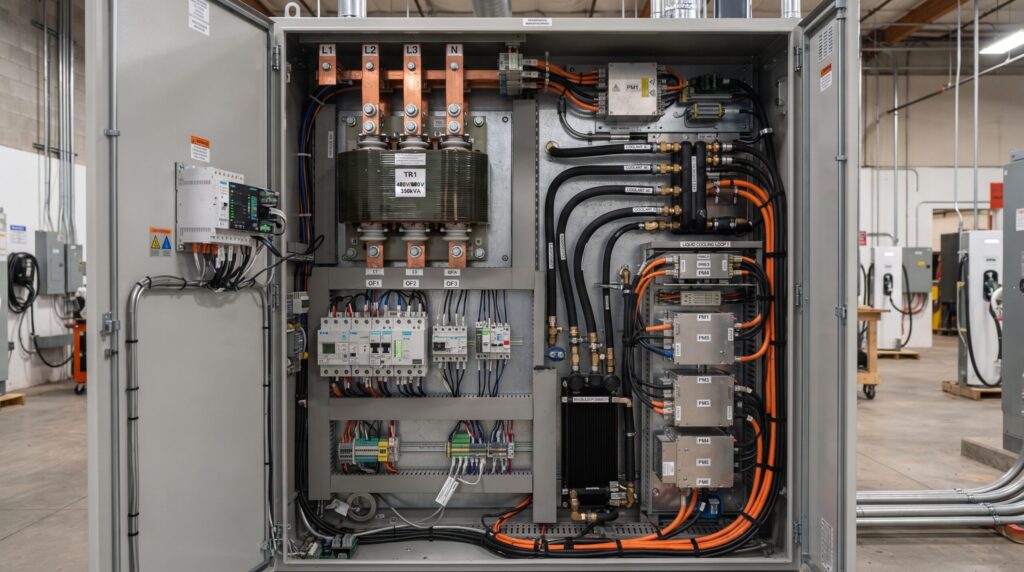
Integrating a centralized modular power cabinet allows commercial properties to scale charging port numbers without repeating invasive ground trenching.
Modular power cabinets consolidate high-voltage rectification and power conversion into one hardened, centralized location away from active parking aisles.
This modular architecture allows facility engineers to increase site output from 150kW to 350kW by inserting extra power modules into existing cabinet slots.
Centralized power distribution reduces physical site footprint while streamlining technician maintenance access during routine service calls.
Managed dynamic load sharing distributes available building amperage dynamically across active vehicles to prevent utility demand charge spikes.
By throttling individual charging ports during peak facility operating hours, property managers eliminate grid upgrade costs that would otherwise exceed $250,000.
Commercial site hosts should pair load management software with onsite battery energy storage systems to buffer high-power charging demand.
Energy storage arrays capture off-peak electricity or solar canopy generation, discharging stored energy during high-tariff utility periods.
This combination lowers operational expenditure while satisfying tenant expectations for fast charging availability.
Mitigating Risk In Multi-Family And Commercial Property Charging
Multi-family housing developments and commercial retail centers represent one of the fastest-growing sectors for EV hardware deployment.
Approximately 33 percent of North American families live in multi-unit residential buildings where dedicated home charging access remains constrained.
Property managers face escalating resident requests for charging amenities, creating risks of unmonitored electrical panel tapping and fire hazard liability.
Installing commercial smart charging stations with built-in access control and automated tenant billing mitigates electrical safety risks.
Property owners retain full visibility over total kilowatt-hour consumption while automatically recovering electricity costs through software integration.
Commercial leases should explicitly outline maintenance responsibilities, network uptime guarantees, and hardware replacement schedules.
Establishing clear operational protocols prevents legal disputes regarding damaged charging handles, vandalism, or unauthorized parking blocking charging bays.
Standardizing on Open Charge Point Protocol hardware prevents vendor lock-in, enabling facility managers to switch software management providers without replacing physical chargers.
Hardware flexibility protects long-term capital expenditure if a network service provider experiences bankruptcy or alters software subscription pricing.
Commercial developers should design site underground conduits to handle twice the initial electrical capacity to simplify future fleet expansion.
Installing larger conduit pathways during initial site grading adds less than 10 percent to total civil engineering costs while eliminating massive retrofitting expenses later.
Mitigating Operational Risks Through Comprehensive Education And Audits
Technical education for property managers and site maintenance staff forms an essential pillar of asset risk mitigation.
Over $2 million of the recent federal clean energy allocation specifically funds 13 regional education and awareness projects across local municipalities.
These programs equip site operators with practical charging literacy, covering connector standards, smart energy metering, and utility interconnection steps.
Educated site managers resolve simple connector latch issues or network resets internally, dramatically reducing costly field service dispatches.
Conducting quarterly physical inspections on high-voltage cables and thermal cooling loops extends hardware operational lifecycle by up to 40 percent.
Routine physical audits identify minor insulation wear, moisture ingress in conduit junctions, and mechanical latch fatigue before electrical shorts occur.
Partnering with certified electrical engineering firms ensures all commercial charger retrofits comply with national electrical codes and municipal structural standards.
Commercial property owners who take proactive measures protect overall asset values while positioning their facilities for long-term fleet electrification demand.
Conclusion
Strategic investments in commercial EV charger infrastructure require balanced planning around electrical capacity, structural enclosure protection, and software load management.
Leveraging federal grant programs like the Zero Emission Vehicle Infrastructure Program allows commercial site hosts to offset significant upfront capital costs.
Facility managers must prioritize high-durability hardware, modular power architecture, and preventative maintenance to avoid unexpected utility penalties and hardware downtime.
Executing a thorough commercial site load assessment provides the foundational data needed to build a scalable, revenue-generating commercial EV charger infrastructure.