Commercial EV charger installation cost planning requires facility executives to evaluate alternating current against direct current delivery before purchasing hardware, as this foundational architectural choice determines long-term capital efficiency.
Misaligning charging speed with tenant dwell times risks six-figure budget overruns in unnecessary switchgear upgrades, extensive trenching, and severe peak demand charges.
Aligning power architecture with real-world driver behavior ensures reliable vehicle replenishment while protecting facility switchgear and future operating budgets.
Disclaimer: This post contains affiliate links. If you click through and make a purchase or submit a request for a quote, we may earn a small commission or referral fee at no extra cost to you.
Table of Contents
Mitigating Risk And Commercial EV Charger Installation Cost
Every commercial facility manager must understand that electricity travels through the public utility grid as alternating current (AC).
Electric vehicle battery packs can only absorb and store electricity as direct current (DC).
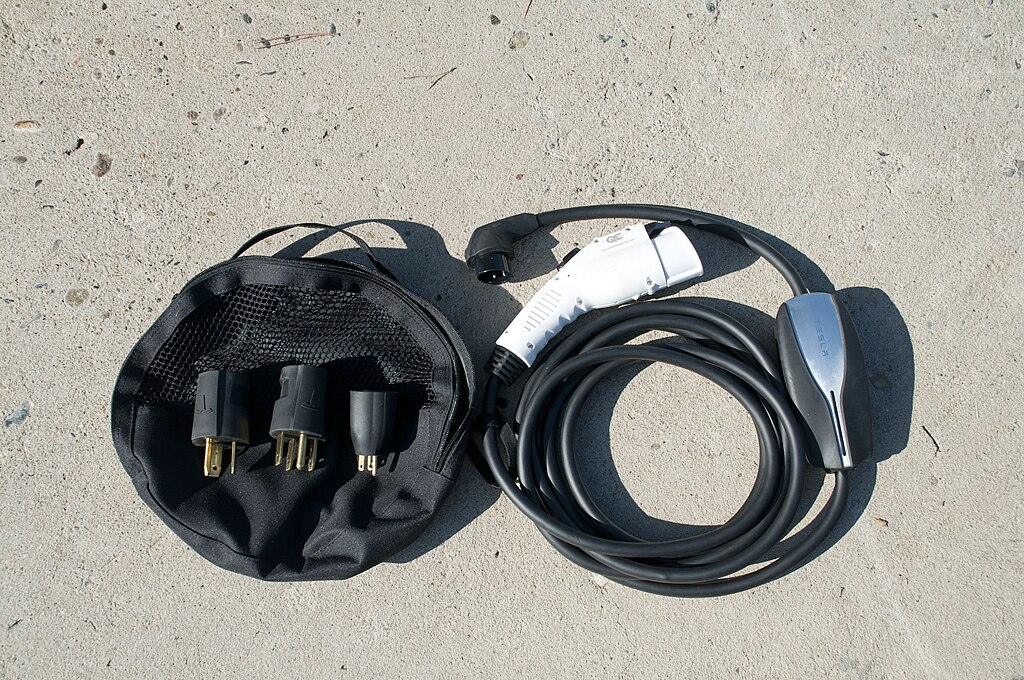
When an electric vehicle plugs into a standard commercial Level 2 AC charging station, the vehicle relies on an internal onboard charger (OBC) to convert incoming grid power into DC power.
This internal conversion process creates a hard physical bottleneck because most vehicle onboard rectifiers cannot handle more than 7.4 kW to 22 kW of continuous throughput.
DC fast charging stations eliminate this bottleneck by converting high-voltage three-phase grid power into DC power inside an external station enclosure before delivering energy directly into the vehicle battery.
This technical distinction creates a massive divergence in structural engineering, electrical room footprint, and total capital expenditure (CapEx).
Deploying a commercial Level 2 AC station generally requires an equipment purchase cost between $500 and $2,000 per port.
Conversely, deploying an industrial DC fast charging cabinet commands hardware capital expenditures ranging from $30,000 to $150,000 per unit.
Commercial property managers who fail to match their infrastructure hardware to tenant dwell times risk over-allocating capital to redundant power capabilities.
Civil engineering costs compound quickly when site plans mandate extensive asphalt trenching, concrete cutting, and directional boring for heavy-duty DC conduit pathways.
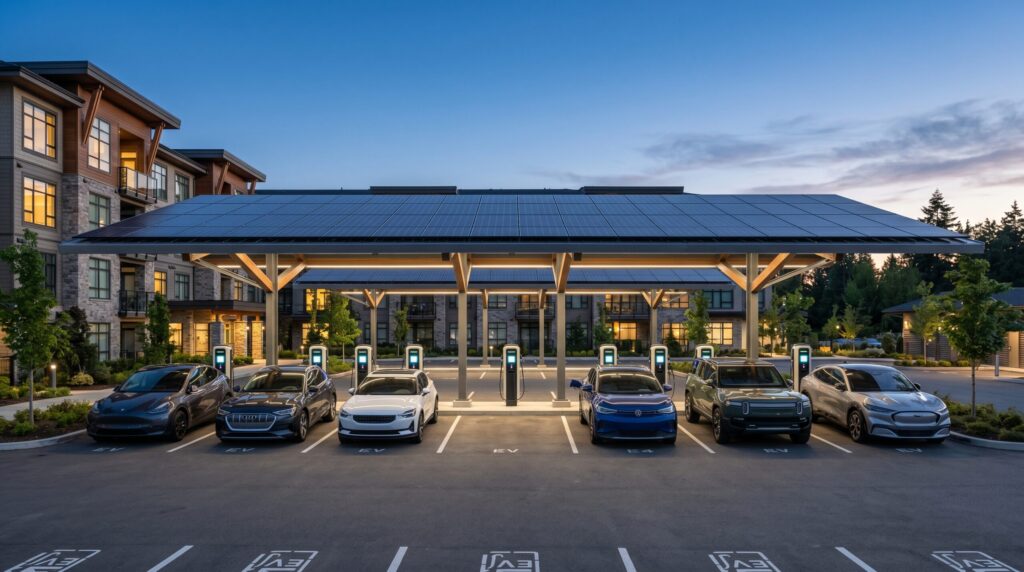
Workplace parking facilities, corporate headquarters, and multi-family communities feature dwell times exceeding six to eight hours where low-amperage AC charging effortlessly restores full operational battery range.
Installing high-output DC fast chargers in long-dwell parking bays represents an unnecessary capital expense that strains facility switchgear without yielding additional operational returns.
Commercial developers must safeguard asset longevity by aligning structural pad installations with real-world driver behavior.
Facility engineers must also prepare for significant utility service upgrade fees whenever DC equipment enters site plans.
A standard commercial Level 2 AC wallbox operates cleanly on common 208V or 240V circuits without requiring main service replacements.
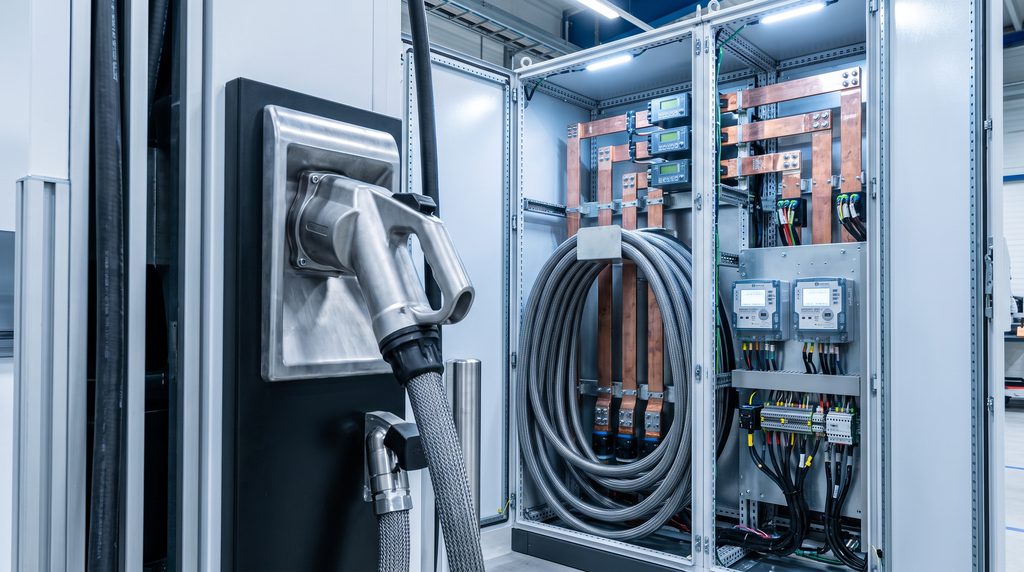
DC fast chargers require dedicated 480V three-phase electrical service and industrial-grade step-down transformers to operate safely.
If your current facility switchgear lacks sufficient ampacity, a utility transformer upgrade can easily add $40,000 to $100,000 in upfront civil and electrical expenses.
Unplanned transformer replacements often cause regulatory delays of six to eighteen months while awaiting public utility interconnection approvals.
Commercial site developers protect their project schedules by conducting comprehensive site load assessments prior to hardware procurement.
Preventative electrical engineering prevents catastrophic breaker trips, phase imbalances, and harmonic distortion across sensitive building automation systems.
Facility managers who proactively map available switchboard ampacity avoid premature service rebuilds and secure reliable operational execution.
Structural Standards And Electrical Enclosure Engineering
Industrial charging hardware placed in exterior parking lots must withstand severe weather conditions, high wind loads, and thermal stress.
Engineers must specify heavy-duty NEMA 3R or NEMA 4X rated enclosures to shield high-power electronics from moisture ingress and corrosive airborne particulates.
DC fast chargers generate substantial internal heat during continuous AC-to-DC rectification and require active liquid cooling loops or high-velocity fan systems.
Neglecting routine filter maintenance and thermal diagnostics will cause premature component degradation and void original manufacturer warranties.
Concrete mounting foundations must adhere to precise structural engineering standards, seismic ratings, and localized wind-velocity building codes.
📋 Commercial Property & Fleet Notice: Prevent unexpected utility penalty fees, switchgear overloads, and unbudgeted transformer replacement expenses by scheduling a comprehensive commercial electrical site load assessment with our master energy engineers today.
Managing Peak Demand Penalties With Modular Power Cabinet Architecture
Commercial property operators face crippling operating expenditure (OpEx) spikes when multiple electric vehicles pull uncontrolled power during peak utility pricing windows.
Electric utilities charge commercial customers hefty demand charges based on the single highest fifteen-minute peak of electrical draw recorded during a billing period.
A single unmanaged 150 kW DC fast charging session initiated during a building’s mid-afternoon peak can trigger thousands of dollars in monthly utility demand penalties.
Deploying a modular power cabinet paired with dynamic load management software allows facility directors to automatically throttle station outputs and eliminate demand spikes.
Dynamic load management software monitors overall building consumption in real time and dynamically assigns available electrical capacity across active vehicle plugs.
This precision energy management strategy enables properties to deploy four times as many vehicle stalls without upgrading their primary utility interconnection breaker.
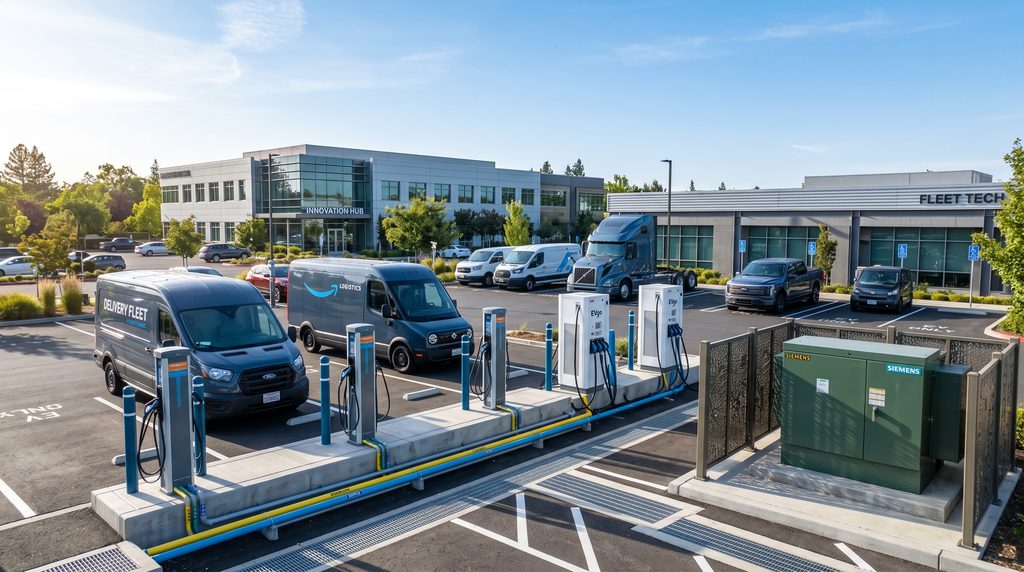
Commercial fleets operating overnight delivery vans achieve maximum cost efficiency by scheduling steady Level 2 AC replenishment during lowest-tier off-peak utility hours.
Conversely, highway travel plazas and high-throughput retail hubs rely on a modular power cabinet design to quickly rotate power between DC dispensing cables as customer vehicles arrive.
Modular architectures allow commercial operators to scale power capacity incrementally from 60 kW up to 360 kW as consumer demand grows over time.
Phased procurement spreads capital expenditures across multiple fiscal quarters while protecting current operating budgets.
Coupling on-site commercial solar carports and stationary battery energy storage systems (BESS) creates a resilient microgrid buffer against escalating grid rates.
Commercial battery systems absorb cheap off-peak or solar-generated energy and discharge instantly during fast charging events to shave expensive utility peaks.
This integrated hardware configuration delivers measurable long-term risk mitigation while securing lucrative ESG building certifications.
Conclusion
Executing a profitable commercial electrification strategy hinges on matching technical AC and DC power delivery systems to site dwell times and electrical capacity.
Commercial property owners who calculate the full commercial EV charger installation cost upfront protect their balance sheets from unbudgeted switchgear retrofits and crippling utility demand charges.
Investing in smart load balancing, modular hardware, and thorough engineering feasibility studies guarantees long-term asset longevity and steady operational performance.