Commercial Managed EV Charging is transforming how properties handle grid demand while lowering peak power costs for commercial real estate owners. Recent regulatory mandates in Connecticut prove that automated load shifting protects electrical infrastructure, reduces utility surcharges, and generates passive revenue…
Disclaimer: This post contains affiliate links. If you click through and make a purchase or submit a request for a quote, we may earn a small commission or referral fee at no extra cost to you.
Table of Contents
Commercial Managed EV Charging Protects Property Assets and Grid Infrastructure
Commercial Managed EV Charging provides commercial property managers, fleet directors, and C&I asset operators with a software-driven mechanism to control facility electrical loads without degrading driver convenience.
On July 1, 2026, the Connecticut Public Utilities Regulatory Authority (PURA) issued a landmark decision under Docket No. 22-08-07, selecting AmpUp’s Adapt & Earn platform as the sole project from Cycle 1 of the state’s Innovative Energy Solutions Program to advance to statewide commercial scaling.
This regulatory decision addresses a fundamental structural vulnerability in commercial power distribution where building owners face severe demand charges during regional peak energy events.
During an extensive 18-month commercial trial conducted alongside regional utility giant Eversource Energy, the software platform managed approximately 1,000 charging ports distributed across 200 distinct commercial sites.
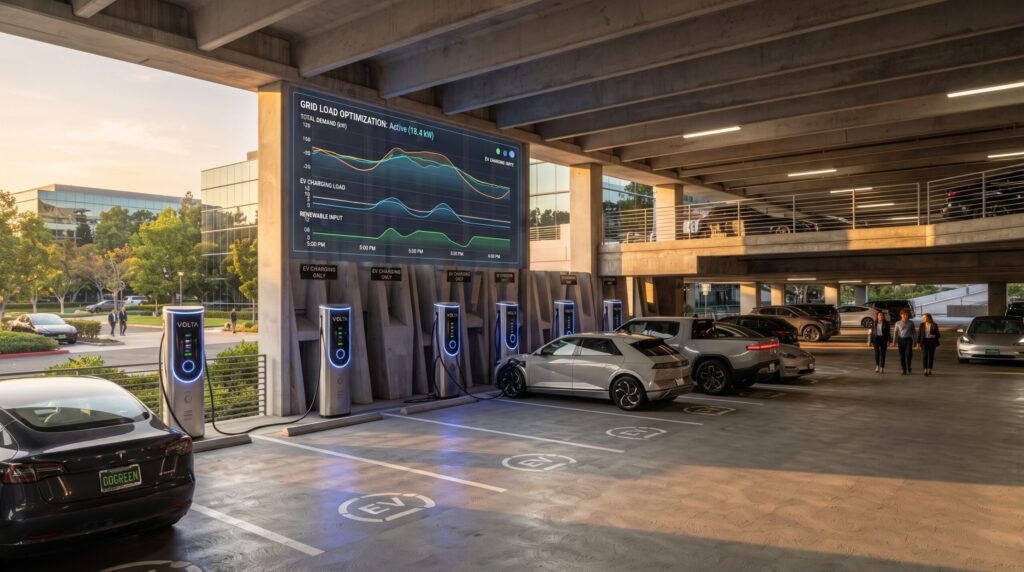
The trial demonstrated that automated software controls can execute subtle charging pauses during critical grid stress periods, shielding facility electrical panels from dynamic thermal overloads.
When an intense summer heatwave caused regional wholesale electricity prices to spike by more than 3,600%, the automated demand response system shifted EV charging loads off-peak at approximately one-third the cost of dispatching traditional fossil-fuel peaker plants.
Property owners who deploy these systems mitigate the operational risk of tripped main breakers, avoid million-dollar utility service entrance upgrades, and retain full structural integrity over their core building power systems.
The trial achieved a 100% site host retention rate across eight commercial customer segments, demonstrating that zero facility managers opted out of automated load management once financial protections were active.
Furthermore, 91% of participating EV drivers reported experiencing zero operational inconvenience during automated charging pauses, proving that short power curtailments do not impact daily commute schedules or fleet readiness.
By eliminating the need for expensive vehicle telematics integrations, proprietary vehicle hardware, or manual driver registration forms, cloud-native software protocols allow commercial sites to participate in utility programs in hours rather than months.
Facilities that fail to implement automated power curtailment risk escalating ratcheted demand charges, which can penalize a property’s monthly utility bill for a full 12-month billing cycle based on a single 15-minute power spike.
In multi-family properties, commercial office parks, and transit hubs, unmanaged Level 2 and DC fast-charging ports act as uncontrolled electrical drains that threaten capital expenditure plans and increase long-term operational costs.
Engineering Heavy-Duty Hardened Envelope Standards for High-Traffic Stations
Deploying commercial charging infrastructure in high-density environments requires careful engineering surrounding structural insulated panels (SIPs), transformer capacity, and weather-hardened enclosures.
Physical charging pedestals installed in exposed outdoor commercial lots must meet strict wind-velocity ratings, NEMA 3R or NEMA 4X ingress protection standards, and heavy-duty structural anchoring to withstand severe weather events.
Integrating modular power cabinets alongside high-durability Level 2 hardware ensures that site infrastructure maintains continuous uptime even under rigorous multi-shift fleet operations.
When combined with precision engineering and dynamic software balancing, site hosts maximize asset longevity while preventing cable fatigue and electrical contact wear.
📋 Commercial Property & Fleet Notice: Is your facility prepared for rising peak-demand charges and local grid power limits? Request a professional commercial site load assessment today to review your electrical service capacity, audit grant eligibility, and implement automated load management to secure your CapEx budget.
Deploying Demand Response Charging Software to Eliminate Utility Demand Penalties
Integrating specialized demand response charging software allows commercial facility engineers to transform static electrical loads into flexible, revenue-generating grid assets.
Unlike residential EV charging where individual homeowners hold direct account relationships with the electric utility, commercial property operators host chargers used by third-party drivers, transit users, and fleet vehicles who do not see the facility’s electric bill.
This division of financial responsibility previously prevented commercial real estate developers from participating in lucrative utility demand response programs.
Modern commercial software platforms overcome this hurdle by distributing platform-native digital wallet credits directly to driver accounts when they permit brief charging pauses.
Drivers receive instant financial compensation inside the mobile app, reducing their overall charging costs by 20% to 30% while the commercial property owner maintains flat power consumption profiles.
This dual-incentive model creates a self-sustaining ecosystem where utility companies lower peak generation procurement costs, site hosts protect transformer health, and drivers enjoy discounted energy rates.
In Connecticut, PURA directed 42% of pilot installation funding toward environmental justice communities, establishing that equitable grid modernization can be achieved alongside commercial profitability.
For fleet managers operating light-duty delivery vans or yard tractors, software-based power capping guarantees that vehicles reach required state-of-charge thresholds before morning dispatch without triggering facility-wide peak demand spikes.
Commercial site hosts receive direct utility incentive payouts deposited into their management accounts, turning necessary parking lot amenities into predictable passive income streams.
As state utility regulators across North America adopt similar managed charging frameworks, commercial developers who integrate smart software architecture will maintain a distinct competitive advantage in tenant retention and asset valuation.
Conducting a Commercial Site Load Assessment to Maximize Return on Investment
Before expanding multi-port charging arrays, property executives must complete a comprehensive commercial site load assessment to determine existing service headroom and transformer capacity.
Installing commercial EV charging hardware without a detailed load analysis frequently leads to unexpected power curtailments, blown main fuses, or forced utility inter-connection delays that stall property developments.
Master site planners evaluate existing facility draw, thermal limits on primary switchgear, and historical interval meter data to establish an optimized baseline for EV load addition.
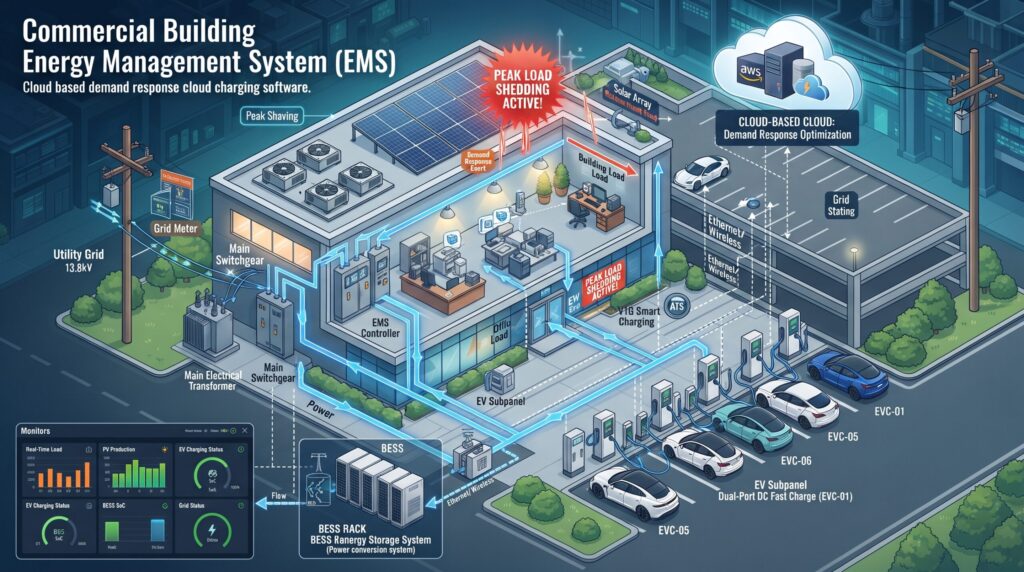
When site load assessments indicate limited electrical capacity, implementing managed charging software allows site hosts to double or triple their installed port count without upgrading physical transformers or main distribution panels.
This software-first approach dramatically reduces initial capital expenditures (CapEx) while accelerating project commission timelines from years down to weeks.
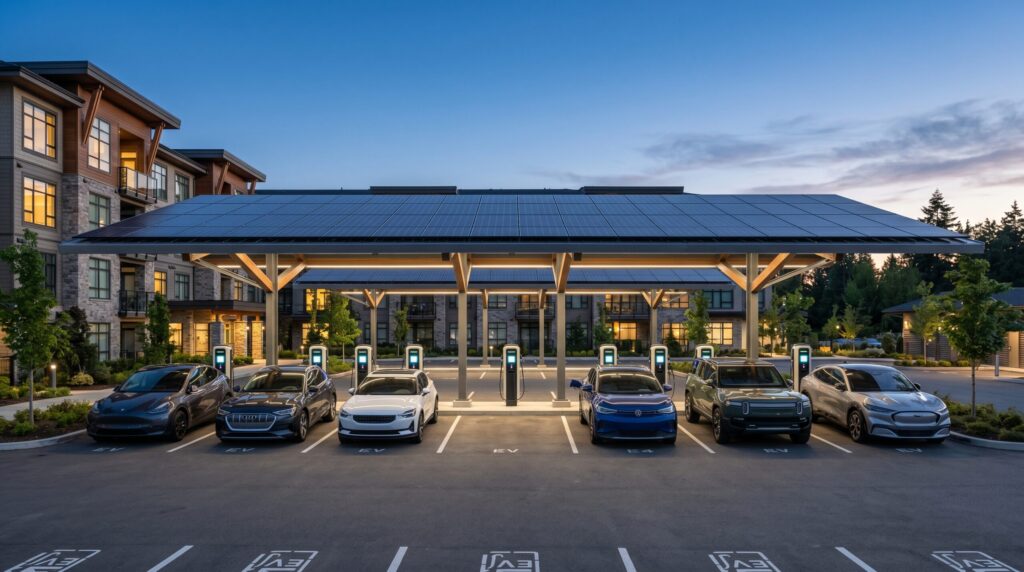
Commercial properties with integrated battery energy storage systems (BESS) and solar canopy structures can further optimize their Total Cost of Ownership (TCO) by discharging stored renewable energy during high-tariff windows.
Facilities that proactively align their electrical master plans with state energy mandates qualify for substantial utility rebates, federal tax incentives, and local infrastructure grants that offset up to 80% of total project costs.
Long-term risk mitigation requires property operators to partner with established engineering, procurement, and construction (EPC) contractors who specialize in commercial energy storage, load orchestration, and utility interconnect negotiations.
By combining physical asset hardening with intelligent energy management, commercial real estate portfolios maintain high operational reliability while actively contributing to regional grid resilience.
Conclusion
Commercial Managed EV Charging has evolved from a simple tenant perk into an essential structural risk mitigation strategy for commercial real estate and fleet operators.
The statewide expansion authorized by Connecticut regulators proves that software-based load management delivers measurable financial relief during extreme grid conditions without interrupting driver routines or requiring costly hardware retrofits.
By implementing dynamic demand response protocols, conducting thorough facility load assessments, and choosing hardened equipment, property managers protect their physical assets, optimize capital expenditures, and lock in long-term operational savings.
Now is the time for commercial developers, fleet operators, and facility managers to audit their electrical infrastructure and embrace managed charging solutions to secure a resilient, cost-effective energy future.