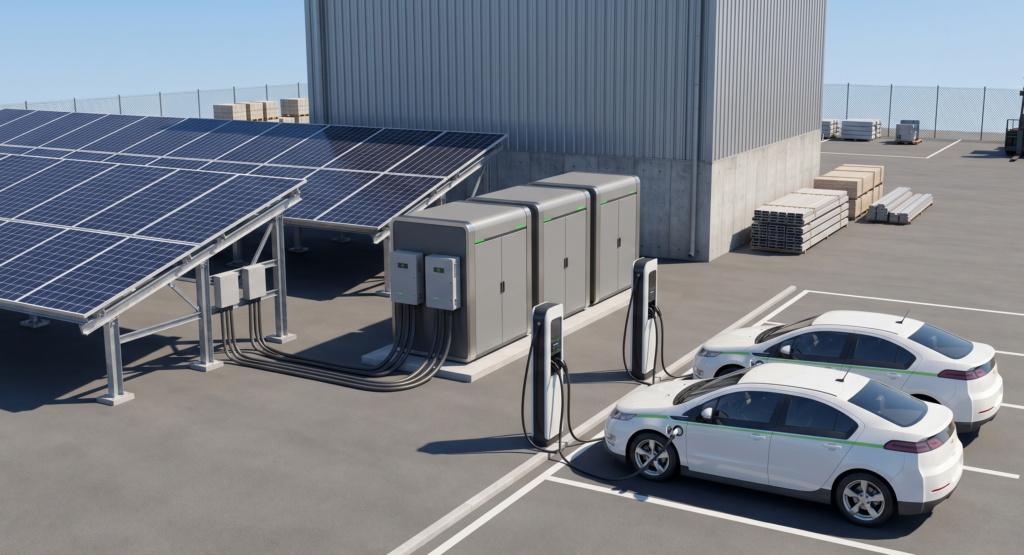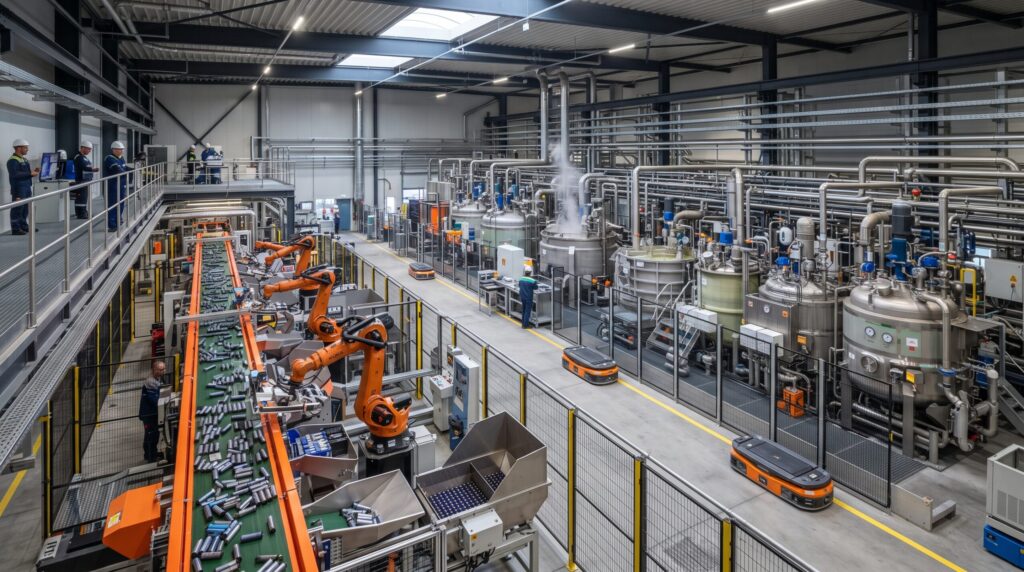
Battery Recycling Legislation is advancing through the United States House Energy and Commerce Committee to transform domestic critical mineral recovery practices. Proposed federal bills aim to modernize outdated regulatory frameworks, streamline lithium-ion battery storage, and reduce reliance on foreign sources…
Disclaimer: This post contains affiliate links. If you click through and make a purchase or submit a request for a quote, we may earn a small commission or referral fee at no extra cost to you.
Table of Contents
How Battery Recycling Legislation Impacts Commercial Facility Energy Infrastructure
Federal lawmakers are moving forward with key legislative updates to overhaul national critical mineral supply chains.
The House Energy and Commerce Subcommittee on Environment recently marked up and approved multiple bipartisan bills designed to reform waste handling rules.
The primary measure under consideration is the Battery Recycling for America’s Competitive Economy Act, known as the BRACE Act.
A complementary measure titled the Coordinating and Harnessing America’s Recovery of Minerals Act, or CHARM Act, was also passed out of subcommittee.
These federal proposals address severe regulatory bottlenecks that currently hamper domestic lithium-ion battery processing.
Commercial property owners and battery energy storage system operators face complex compliance challenges when managing end-of-life battery assets.
Current regulations under the Resource Conservation and Recovery Act have not undergone substantial updates since 1995.
These legacy regulations predate the widespread adoption of large-scale commercial battery systems and electric vehicle fleets.
Under existing rules, spent energy storage units and industrial lithium-ion packs are often classified as hazardous waste rather than universal waste.
This hazardous designation imposes costly storage limits, strict permitting rules, and burdensome transport protocols on facility operators.
Because domestic facilities face high compliance costs under legacy rules, vast quantities of valuable battery scrap are exported overseas for processing.
Foreign processing hubs, particularly in China, currently dominate the global market for critical mineral extraction.
The new legislative framework mandates that the Environmental Protection Agency finalize clear universal waste standards for lithium-ion units within eighteen months.
Modernizing these rules allows commercial facility managers to integrate safer, streamlined battery collection points directly within industrial sites.
Facility envelopes must be constructed to withstand severe physical environments while housing high-density energy storage assets.
Hardened building envelopes utilizing reinforced concrete and structural insulated panels provide necessary fire isolation for indoor battery collection spaces.
Proper structural standards and high wind-velocity ratings protect stationary storage installations from catastrophic weather events.
Removing regulatory barriers reduces the overhead cost of maintaining dedicated on-site battery storage enclosures.
Commercial facilities can capture significant financial value by participating in organized domestic recycling programs.
Updating federal waste handling rules allows commercial developers to plan long-term capital expenditure projects with greater regulatory certainty.
Commercial battery installations require ongoing preventative maintenance to ensure thermal stability and long-term operating efficiency.
Battery management systems continuously monitor cell voltage, ambient temperature, and internal resistance across stationary storage arrays.
When stationary battery modules reach the end of their operational lifecycle, site managers require clear disposal pathways.
Streamlined environmental regulations prevent spent battery modules from sitting indefinitely in facility storage yards.
Prolonged storage of decommissioned lithium-ion cells increases thermal runaway risks and elevates facility insurance premiums.
Establishing designated, legally compliant collection areas reduces environmental liabilities for commercial property management firms.
💡 Pro Tip: When decommissioning commercial energy storage systems, partner directly with certified recycling vendors who provide certified chain-of-custody documentation to mitigate strict environmental liability under federal waste regulations.
Advanced Hydrometallurgy Processing Systems Drive Critical Mineral Recovery Yields
The BRACE Act directly targets the technical operations of battery recycling facilities and destination sites.
Under legacy Resource Conservation and Recovery Act guidelines, recycling plants designated as destination facilities faced mandatory hazardous waste permits.
Obtaining these complex federal permits can take several years and cost millions of dollars in administrative overhead.
To avoid these permitting hurdles, recyclers often stored raw batteries at off-site staging locations before processing.
This double-handling process added unnecessary logistics costs and increased transit risks for bulk battery shipments.
The proposed legislation eliminates regulatory duplication, allowing direct shipment to certified processing centers.
Modern recycling centers utilize two primary mechanical and chemical methods to recover critical elements from spent battery cells.
First, mechanical shredding systems crush decommissioned battery modules inside inert gas chambers to prevent volatile thermal reactions.
The shredded materials pass through magnetic separators, air shifters, and vibrating screens to isolate structural metals like aluminum casing and copper foil.
This mechanical separation yields a concentrated material powder known in the industry as black mass.
Black mass contains high concentrations of valuable cathode active materials, including nickel, cobalt, manganese, and lithium carbonate.
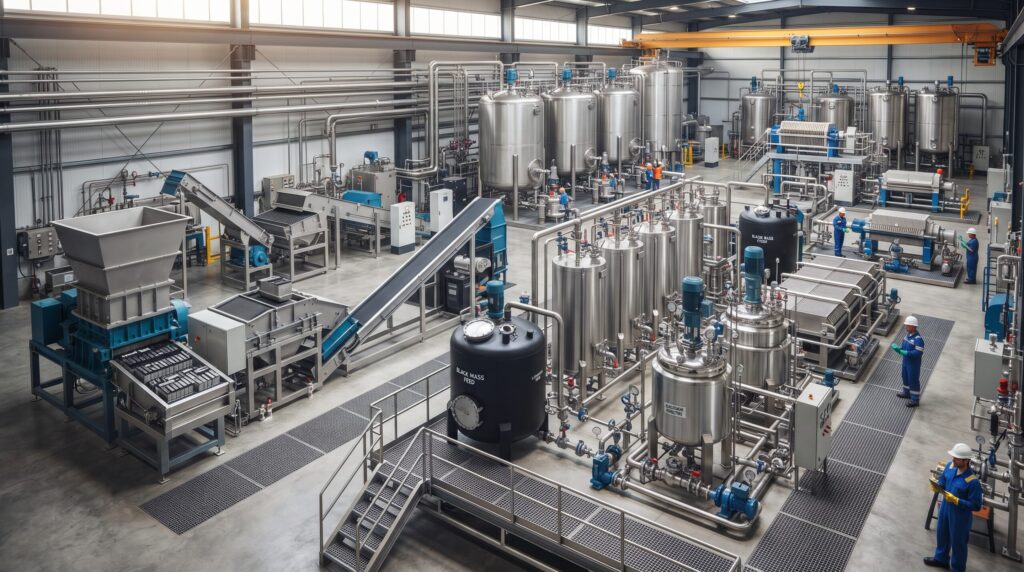
Second, facility operators deploy advanced hydrometallurgy processing systems to extract pure elemental metals from the raw black mass powder.
Hydrometallurgical extraction uses aqueous acid solutions to dissolve the black mass at controlled temperatures and pressures.
Precision chemical precipitation and solvent extraction circuits then isolate individual metal ions with high chemical purity.
Compared to traditional pyrometallurgical smelting, hydrometallurgical processing operates at lower thermal temperatures and emits significantly fewer greenhouse gas emissions.
Hydrometallurgy yields battery-grade chemical compounds that can be fed directly back into cathode manufacturing supply chains.
Equipment manufacturers continue to improve filter presses, leaching vats, and crystallization units to maximize mineral recovery efficiency.
High-purity chemical recovery reduces the need for virgin raw material mining and stabilizes domestic battery supply chains.
Commercial fleet operators benefit from a stabilized domestic supply of replacement battery packs and energy storage modules.
Commercial Asset Risk Mitigation Strategies for Industrial Fleet and Facility Managers
The CHARM Act mandates that the Environmental Protection Agency create a comprehensive National Critical Mineral Recovery Strategy within two years.
This national strategy establishes clear federal guidelines for recovering high-value elements from industrial, commercial, and municipal waste streams.
Industrial fleet directors and commercial real estate developers must align their asset management protocols with these emerging federal standards.
Implementing proactive commercial asset risk mitigation practices ensures long-term operational resilience and regulatory compliance.
Fleet managers operating heavy electric yard tractors, commercial delivery vans, and transit buses face unique battery lifecycle challenges.
Commercial electric vehicle batteries degrade over time due to repeated high-voltage fast charging and extreme thermal cycles.
When a fleet battery capacity drops below eighty percent of its original specification, it is no longer suitable for demanding vehicle operations.
However, these degraded packs retain substantial energy capacity suitable for secondary stationary storage applications.
Secondary life applications include pairing degraded fleet batteries with C&I solar arrays to buffer peak facility electrical demand.
When secondary battery assets finally reach absolute end-of-life, facilities must execute structured recycling workflows.
Properly handling end-of-life battery packs protects commercial property values and prevents costly environmental remediation fines.
Facilities should install designated concrete pads with secondary containment barriers to store decommissioned battery racks safely.
Environmental monitoring systems, including off-gas detectors and infrared thermal cameras, should be installed in all battery staging areas.
Routine field inspections ensure that physical battery casings remain structurally sound and free from electrolyte leakage.
Training maintenance staff on high-voltage safety procedures reduces workplace hazards during battery removal and staging.
Standardized recycling workflows streamline logistics and ensure compliance with municipal and federal environmental guidelines.
Commercial property developers who integrate dedicated recycling access zones into site plans enhance overall building asset valuations.
Streamlined recycling workflows directly lower long-term facility capital expenditure by recovering residual scrap value from retired energy assets.
Financial Capital Expenditures and Policy Outlook for Domestic Clean Tech Chains
Federal legislative reforms represent a major structural shift toward a localized circular energy economy.
The United States Department of Energy has also allocated billions of dollars in grants to expand domestic battery manufacturing and recycling facilities.
These federal grant programs support commercial-scale facility construction, equipment retrofits, and advanced technology demonstration projects.
Private capital investment is flowing rapidly into domestic recycling infrastructure as regulatory barriers fall.
Major C&I energy storage developers are incorporating end-of-life recycling guarantees into standard procurement contracts.
These contractual guarantees provide facility owners with predictable long-term asset residual values.
Predictable residual values reduce total cost of ownership metrics for large-scale solar and stationary battery deployments.
Property managers can leverage sustainable waste credentials to meet corporate ESG targets and attract premium commercial tenants.
Reducing reliance on foreign critical mineral suppliers shields domestic clean tech industries from international supply chain disruptions.
Domestic recycling facilities ensure that valuable materials like lithium, nickel, cobalt, and copper remain within the national economy.
Updated regulations under the Resource Conservation and Recovery Act will clarify operational requirements for waste management contractors.
Clear regulatory frameworks encourage investment in specialized collection trucks, containment packaging, and automated sorting hardware.
Industrial waste management companies can expand their service portfolios by offering specialized lithium-ion logistics solutions.
Collaborative industry partnerships between battery manufacturers, fleet operators, and recyclers accelerate technical innovation.
Shared engineering insights improve battery module designs, making future battery packs easier to disassemble and recycle.
Standardizing battery module architecture lowers mechanical processing costs and improves elemental recovery rates.
Bipartisan congressional support for the BRACE Act and CHARM Act indicates long-term political stability for domestic recycling policies.
Commercial real estate stakeholders who adapt early to these regulatory changes will secure a strong competitive advantage in sustainable energy infrastructure.
Conclusion
Passing modernized Battery Recycling Legislation creates a clear roadmap for domestic critical mineral recovery across the commercial sector.
Updating legacy federal rules removes unnecessary administrative burdens and lowers compliance costs for facility operators.
Commercial property managers and fleet operators can safely integrate streamlined battery storage and recycling practices into daily operations.
Advanced recycling technologies protect national security while building a resilient, circular clean energy supply chain.
Industry stakeholders must remain proactive in adopting updated environmental standards to maximize facility asset valuations and long-term sustainability.