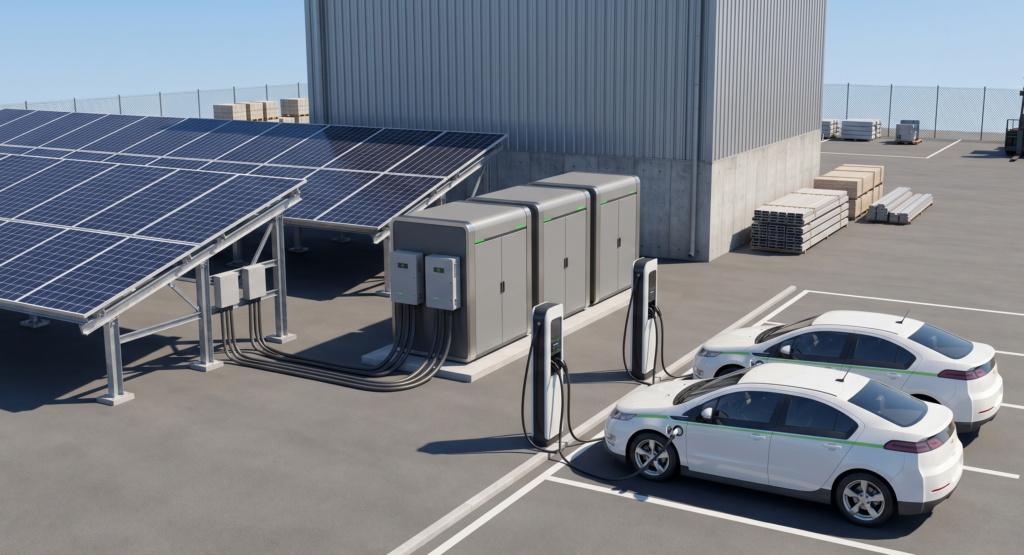
Commercial EV charger installation cost planning requires facility executives to evaluate alternating current against direct current delivery before purchasing hardware, as this choice directly determines long-term capital efficiency.
Misaligning charging capacity with actual driver dwell times risks six-figure overruns from unnecessary switchgear upgrades, extensive trenching, and severe peak demand charges.
Disclaimer: This post contains affiliate links. If you click through and make a purchase or submit a request for a quote, we may earn a small commission or referral fee at no extra cost to you.
Table of Contents
Mitigating Grid Deficits With Utility-Scale Battery Storage System Architecture
A utility-scale battery storage system delivers immediate, high-output power dispatch to protect massive electrical infrastructure from catastrophic grid failure.
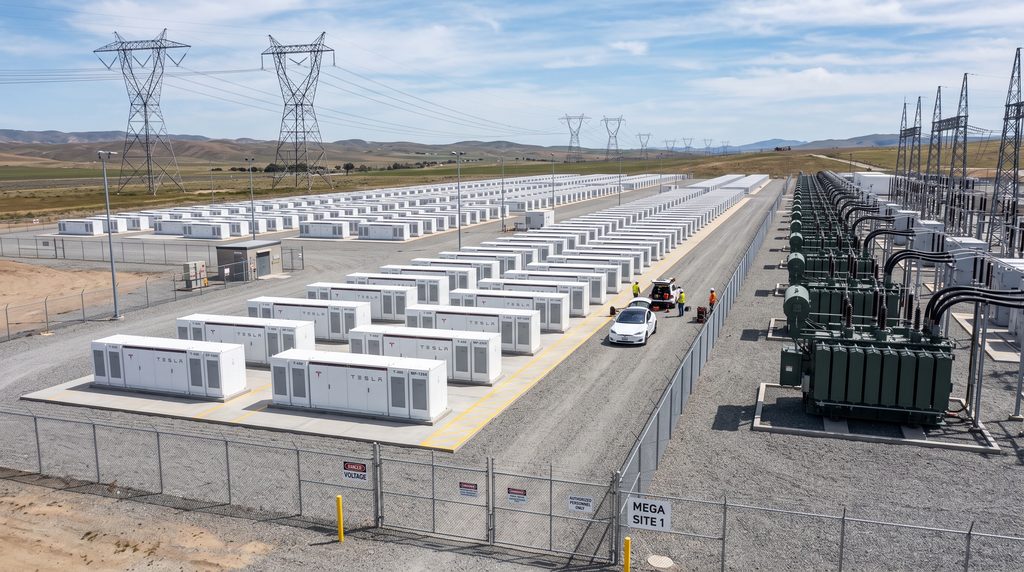
The recent deployment of approximately 720 Tesla Megapack enclosures at the Memphis Colossus 2 computing hub illustrates the rapid evolution of private microgrids.
This massive installation establishes between 2.8 gigawatt-hours and 3.3 gigawatt-hours of total dedicated energy storage capacity.
The facility commands an unprecedented instantaneous discharge potential ranging from 720 megawatts up to 2,000 megawatts of behind-the-meter reserve power.
For commercial property developers, industrial operators, and data facility managers, deploying a utility-scale battery storage system is no longer merely an ESG initiative.
Industrial power consumers must recognize that localized utility infrastructure faces extreme physical congestion.
Public utilities like the Tennessee Valley Authority (TVA) and municipal operators like Memphis Light, Gas and Water (MLGW) enforce strict demand limits on heavy industrial customers.
When hyper-dense computing loads or heavy EV fleet depots draw continuous power, they risk triggering massive financial penalties from local utilities.
Unmanaged electrical spikes force utilities to levy five-figure monthly demand penalties against unprepared property operators.
Private battery infrastructure functions as a critical operational buffer that eliminates these peak charges entirely.
Commercial facilities that operate behind-the-meter storage systems can seamlessly isolate their operations during regional energy emergencies.
This operational autonomy protects expensive sensitive equipment from brownouts, voltage dips, and total power interruptions.
Executing a multi-megawatt energy deployment requires direct alignment with municipal power authorities and federal power grids.
Without private battery capacity, massive industrial projects face interconnection delays stretching between two and five years.
By deploying on-site energy storage, facility engineers bypass local substation bottlenecks and secure immediate operational readiness.
Hardware procurement represents only one component of a successful large-scale energy deployment.
Commercial operators must allocate substantial capital expenditure toward civil works, pad foundations, and switchgear integration.
Securing high-voltage transformers and medium-voltage switchgear requires early supply chain planning to prevent year-long construction stalls.
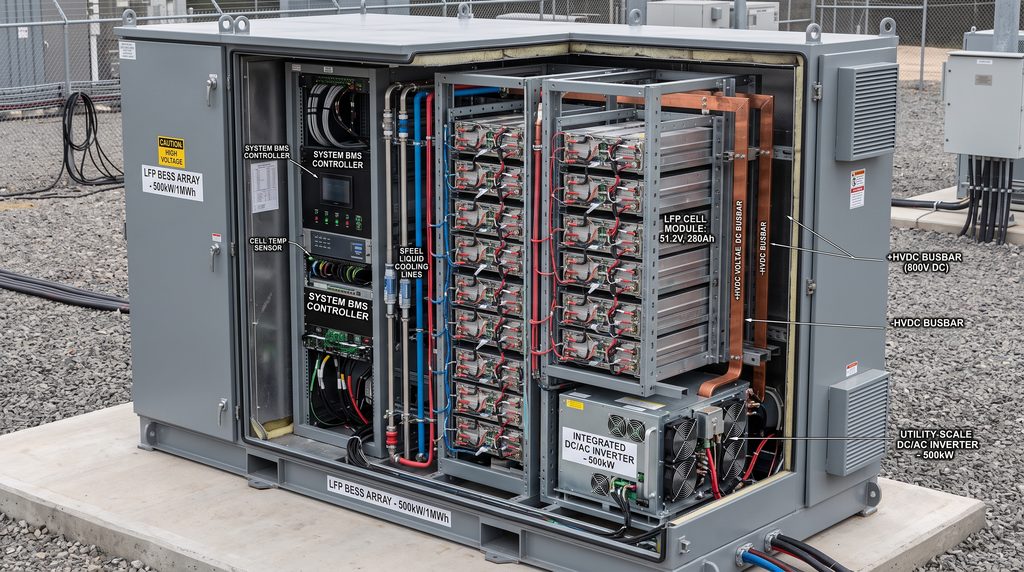
High-power battery installations generate substantial internal thermal energy that must be actively dissipated.
Modern commercial installations utilize advanced liquid cooling systems to maintain optimal internal cell temperatures during rapid discharge cycles.
Failure to maintain steady thermal conditions accelerates cell degradation and drastically reduces the financial lifespan of the hardware asset.
Property owners must enforce strict preventive maintenance protocols, including coolant loop flushes and ultrasonic terminal inspections.
Rigorous thermal management guarantees that high-output battery assets maintain their full rated capacity throughout their warrantied operational life.
Structural Standards And Thermal Enclosure Engineering
Industrial energy storage enclosures installed in exterior locations must comply with rigorous physical and environmental safety codes.
Civil engineers must specify heavy-duty NEMA 3R or NEMA 4X steel enclosures to prevent water intrusion and airborne contaminant damage.
Outdoor electrical equipment must adhere to precise wind-velocity ratings capable of surviving severe hurricane-force storms and seismic tremors.
Foundations must incorporate structural insulated panels and precision-engineered concrete pads to prevent ground settlement over decades of use.
Battery modules utilizing high-density energy cells require integrated fire suppression systems adhering strictly to NFPA 855 safety standards.
Thermal runaway protection requires continuous gas detection sensors, automated deflagration venting, and remote emergency electrical isolation switches.
Corporate directors must ensure that all pad-mounted equipment satisfies localized municipal zoning clearances and environmental setback rules.
📋 Commercial Property & Fleet Notice: Prevent unexpected utility penalty fees, substation bottlenecks, and unbudgeted switchgear retrofit expenses by scheduling a comprehensive commercial electrical site load assessment with our master energy engineers today.
Capitalizing On An LFP Battery Array To Slash Operational Risk
Deploying a commercial-grade LFP battery array gives property managers the ultimate hedge against fluctuating commercial electric utility tariffs.
Lithium iron phosphate chemistry provides exceptional chemical stability, long cycle life, and low risk of thermal runaway compared to older chemistries.
Industrial facility managers utilize an LFP battery array to capture cheap, off-peak energy and discharge during expensive on-peak billing intervals.
This operational method, known as peak shaving, reduces utility demand charges by up to forty percent annually.
A multi-megawatt battery array can also participate in regional utility demand response programs to generate recurring ancillary revenue streams.
Municipal utilities actively compensate large commercial battery operators who agree to curtail consumption or supply energy during grid distress.
Doug McGowan, CEO of Memphis Light, Gas and Water, highlighted that massive on-site batteries provide critical backup when facilities must curtail consumption.
This dual capability transforms a passive backup asset into an active revenue-generating component of a corporate balance sheet.
Securing regulatory approvals for large battery arrays requires close coordination with regional utility transmission authorities.
The Tennessee Valley Authority board granted crucial grid interconnection approvals after evaluating the comprehensive electrical protection schemes of the Memphis facility.
Large corporate developers spent over $430 million on battery hardware in prior fiscal cycles to secure their multi-gigawatt energy pipelines.
An additional $405 million in hardware purchases demonstrates the massive capital allocation flowing directly into private behind-the-meter storage assets.
Commercial operators who delay infrastructure procurement risk falling behind aggressive corporate competitors who control their own power generation.
The arrival of next-generation hardware like the Tesla Megapack 3 accelerates deployment velocity while maximizing energy density per square foot.
Higher energy density allows developers to install greater storage capacity on limited industrial land footprints.
Compact pad footprints substantially reduce site acquisition costs, concrete pouring volume, and underground conduit trenching expenses.
Every square foot saved in switchyard planning translates directly into lower upfront civil engineering expenses and faster payback periods.
Protecting these capital-intensive electrical assets requires comprehensive site load assessment workflows before ordering equipment.
Commercial developers who commission rigorous site load studies identify switchgear limitations and breaker capacity constraints early.
Early engineering diagnostics eliminate cost overruns, avoid transformer rebuilds, and ensure rapid, hassle-free utility interconnection.
Benchmarking Megawatt Capacity Against National Utility Assets
Evaluating the Memphis battery deployment reveals a fundamental transformation in private electrical asset scale.
Prior to this installation, the Edwards & Sanborn solar and storage facility in Kern County, California, represented the nation’s largest operational battery facility.
The Edwards & Sanborn complex features over 1,066 megawatts of power capacity and 3,287 megawatt-hours of total energy storage.
If the Colossus 2 installation achieves its full projected 2,000-megawatt operating threshold, it will surpass existing utility benchmarks.
Private enterprise is now deploying utility-scale energy infrastructure that rivals or exceeds regional municipal public utilities.
This transition proves that massive computing loads, EV charging hubs, and industrial manufacturing plants require dedicated local power assets.
Relying solely on aging public utility lines leaves multi-million-dollar commercial assets vulnerable to prolonged downtime.
Commercial property owners must view behind-the-meter storage as necessary operational insurance against grid volatility.
Facility engineers must also integrate advanced automated energy management systems (EMS) to direct real-time power routing.
An intelligent EMS continuously tracks wholesale utility spot prices, internal building consumption, and available battery state-of-charge.
When grid power pricing spikes, the intelligent software instantly dispatches stored battery power to run the facility off-grid.
When wholesale utility rates drop to low or negative tiers overnight, the automated software recharges the battery modules at rock-bottom cost.
This continuous optimization algorithm delivers predictable, reduced operating expenses across volatile energy markets.
Long-term risk mitigation requires property executives to align hardware procurement with institutional warranty coverage.
Tier-one battery manufacturers provide ten to twenty-year capacity retention guarantees when equipment operates within defined thermal thresholds.
Commercial developers protect their multi-million-dollar balance sheets by ensuring certified EPC contractors handle every phase of commissioning.
Proper installation practices guarantee that all electrical terminations, grounding rods, and circuit protection devices function flawlessly.
Investing in high-standard electrical infrastructure protects operational continuity, mitigates utility penalties, and secures long-term enterprise valuation.
Conclusion
Industrial facility operators must recognize that a utility-scale battery storage system provides unmatched operational resilience, peak-demand penalty protection, and long-term energy cost certainty.
Commercial real estate directors and fleet managers who invest in comprehensive site feasibility studies position their balance sheets for sustained profitability.
Implementing modular, liquid-cooled battery hardware protects multi-million-dollar enterprises against severe regional grid instability and escalating utility rate structures.
Securing your facility’s energy future demands precision engineering, proactive utility coordination, and an uncompromised commitment to a modern utility-scale battery storage system.