Bidirectional EV Charging Networks enable commercial real estate developments to transform parked electric fleets into dynamic battery storage assets. Commercial property managers leverage two-way power flow to reduce facility utility bills, avoid severe peak demand penalties, and stabilize electrical infrastructure…
Disclaimer: This post contains affiliate links. If you click through and make a purchase or submit a request for a quote, we may earn a small commission or referral fee at no extra cost to you.
Table of Contents
Bidirectional EV Charging Networks Transform Commercial Energy Management
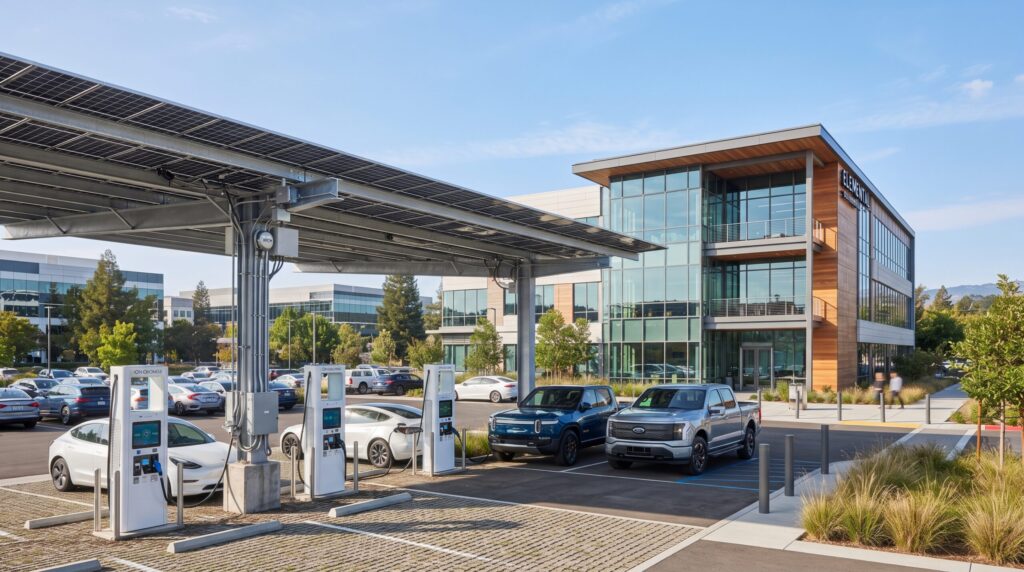
Bidirectional EV Charging Networks allow commercial property developers and facility engineers to convert stationary fleet vehicles into active distributed energy resources.
Integrating two-way power flow enables facility managers to draw energy from the utility grid during off-peak hours and discharge stored vehicle power back into the building when electricity rates spike.
This process, known as Vehicle-to-Building (V2B) or Vehicle-to-Grid (V2G) technology, creates an automated buffer against high commercial demand charges.
When dozens of electric passenger vehicles or delivery vans plug into a site during peak operational hours, conventional one-way charging adds significant electrical load.
Unmitigated charging spikes can trigger utility demand penalties exceeding $20,000 per month for large commercial facilities.
By reversing the electricity flow, bidirectional systems draw kilowatts out of vehicle batteries to supply onboard building loads such as lighting, HVAC equipment, and industrial machinery.
This peak shaving mechanism insulates commercial facility budgets from volatile local utility rate structures.
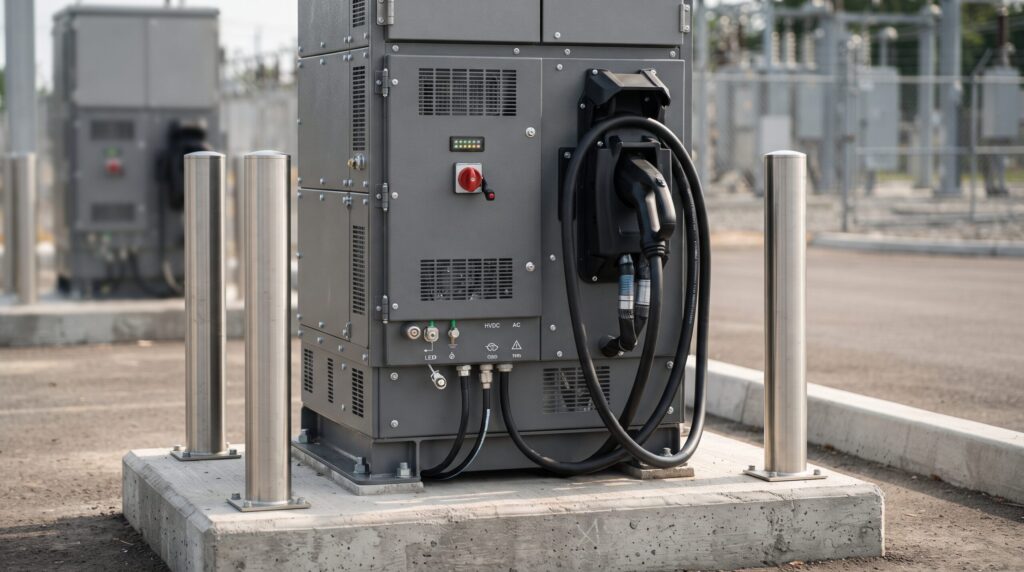
Commercial site hosts protect long-term capital expenditure by implementing precision engineering standards during early site design.
Installing electrical enclosures built with structural insulated panels (SIPs) and high-grade wind-velocity ratings prevents environmental degradation of sensitive power electronics.
Heavy-duty crash bollards and reinforced concrete mounting pads shield high-voltage dispensers from vehicle collisions in busy commercial parking decks.
Proper site hardening ensures that expensive bidirectional hardware maintains long-term risk mitigation standards and preserves asset longevity.
📋 Commercial Property & Fleet Notice: Prevent severe peak demand penalties and protect facility power quality by booking a professional commercial site load assessment and engineering audit today.
Integrating Modular Bidirectional Power Inverter Hardware For Grid Stability
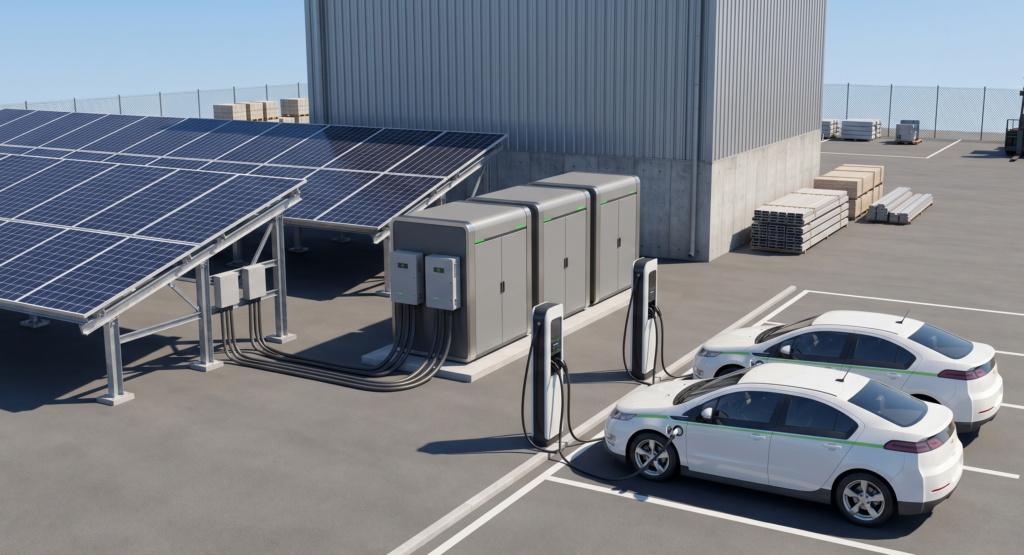
Modern commercial energy architectures require facility engineers to deploy a specialized modular bidirectional power inverter setup to handle two-way power conversion efficiently.
Unlike standard Level 2 chargers that only deliver alternating current (AC) to an onboard vehicle charger, bidirectional fast charging systems utilize direct current (DC) power cabinets.
These advanced power cabinets incorporate internal silicon carbide inverters that seamlessly convert DC battery energy back into three-phase AC power synchronized with the facility grid.
Deploying standardized communication protocols like ISO 15118-20 ensures interoperability between diverse EV models and site management software.
ISO 15118-20 establishes secure, automated data exchange that coordinates vehicle discharge limits, battery state-of-charge parameters, and grid signals in real time.
This communication standard prevents excessive battery degradation by keeping discharge depth within strict limits defined by fleet managers.
By integrating universal SAE J3400 NACS connectors alongside open software standards, commercial property owners future-proof their physical charging infrastructure.
Evaluating The Commercial EV Charger Installation Cost Against Peak Demand Savings
Analyzing the upfront commercial EV charger installation cost requires property developers to calculate direct energy cost offsets over a multi-year operating period.
A typical commercial bidirectional station installation ranges from $15,000 to $50,000 per port depending on panel capacity upgrades, utility transformer steps, and trenching distances.
However, commercial properties utilizing smart load management can offset these capital investments within three to five years.
During summer peak periods, commercial utility rates can jump from $0.10 per kWh to over $0.40 per kWh during afternoon stress hours.
Discharging a 100 kWh fleet vehicle battery during four hours of peak demand reduces facility grid draw by up to 25 kW per vehicle.
A fleet of ten connected commercial vehicles discharging simultaneously delivers 250 kW of capacity directly to the building main switchgear.
This offset eliminates thousands of dollars in monthly utility demand charges while earning potential revenue through utility demand response programs.
Furthermore, commercial property owners can leverage federal tax credits, regional air quality grants, and utility rebates that offset up to 30% or more of the initial equipment expenditure.
Long-Term Risk Mitigation And Preventative Maintenance For Commercial Chargers
Managing bidirectional electrical infrastructure requires proactive operational oversight to prevent equipment wear and maintain grid compliance.
Continuous high-current two-way power flow places additional thermal stress on liquid-cooled charging cables, internal contactors, and utility isolation transformers.
Facility managers must schedule routine preventative maintenance that includes thermal imaging audits of high-voltage connection points and switchgear.
Identifying hotspot resistance before component failure occurs prevents costly unmitigated downtime and preserves equipment warranties.
Site operators should also mandate compliance with UL 9741 safety standards for bidirectional electric vehicle supply equipment.
UL 9741 compliance guarantees that the charger immediately isolates from the grid during power outages, preventing dangerous islanding that could harm utility line workers.
Partnering with certified electrical engineering contractors ensures that all physical site modifications comply with national electrical codes and local utility interconnection agreements.
Conclusion
Bidirectional EV Charging Networks offer commercial real estate owners and fleet operators an unprecedented mechanism to monetize parked vehicles and lower overall facility energy costs.
Transitioning from standard charging equipment to high-power bidirectional infrastructure requires careful civil engineering, utility coordination, and hardened structural design.
By investing in standardized ISO 15118-20 hardware and implementing proactive load management software, commercial properties protect long-term capital assets.
Strategic bidirectional energy management preserves property values, enhances facility resilience, and sets new financial standards for commercial building operations.