Home vs public charging determines whether your electric vehicle saves thousands of dollars or quietly drains your monthly budget.
Your choice between plugging in overnight at home and relying on highway fast chargers changes your fueling bill dramatically.
Most everyday drivers slash their annual energy expenses by up to 65% simply by charging in their own garage.
Understanding real kilowatt-hour math helps you pick the smartest setup for your driveway, apartment carport, or weekend road trips.
Disclaimer: This post may contain affiliate links. If you click through any of the links in the article and make a purchase or submit a request for an installer quote, we may earn a small commission or referral fee at no extra cost to you.
Table of Contents
Why Home vs Public Charging Shapes Your Yearly Budget
Home vs public charging comes down to one simple number: you pay roughly $0.18 per kilowatt-hour at home versus $0.54 on the road.
That threefold price gap turns a routine weekly top-up into a major financial decision for every retail EV buyer.
When you plug into a standard residential outlet or wall box, your utility company bills you wholesale residential electricity rates.
Public charging networks add commercial demand fees, equipment maintenance markups, and real estate overhead onto every single kilowatt-hour you buy.
For example, filling an empty 75 kWh battery pack in a Tesla Model 3 or Hyundai IONIQ 5 costs roughly $13.62 at home.
Filling that exact same 75 kWh battery at a public DC fast charger averages $40.50 before idle fees or taxes.
Core Hardware Highlights At A Glance
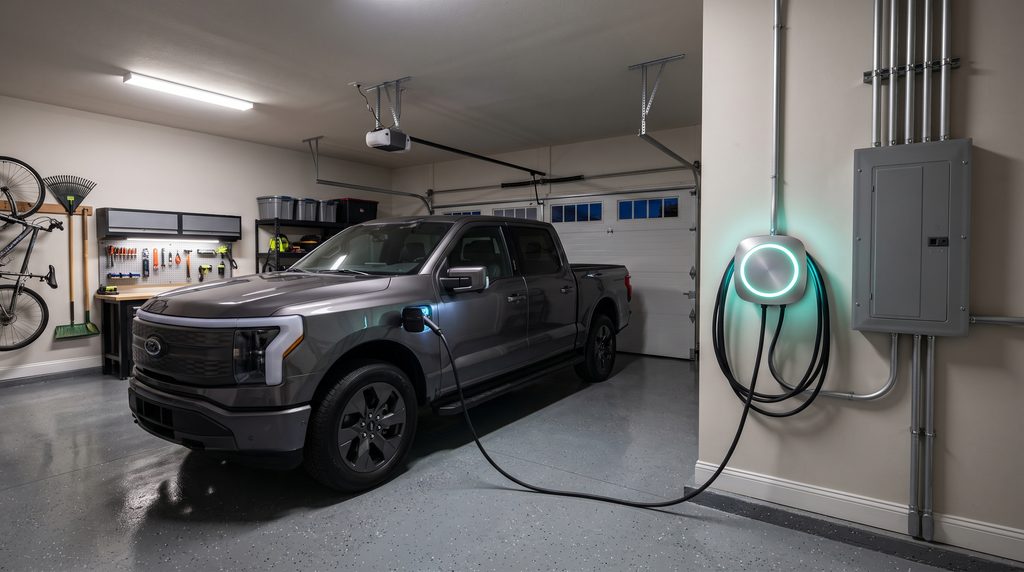
- Residential Level 2 Wall Boxes: Units like the Emporia Classic ($399) and ChargePoint Home Flex ($549) deliver 40 to 48 amps over split-phase 240V circuits.
- UL 2594 Safety Certification: Certified home stations regulate heat buildup and prevent tripped breakers during continuous overnight charging sessions.
- Time-of-Use Scheduling: Built-in Wi-Fi apps automatically delay power draw until midnight when utility rates drop as low as $0.09 per kWh.
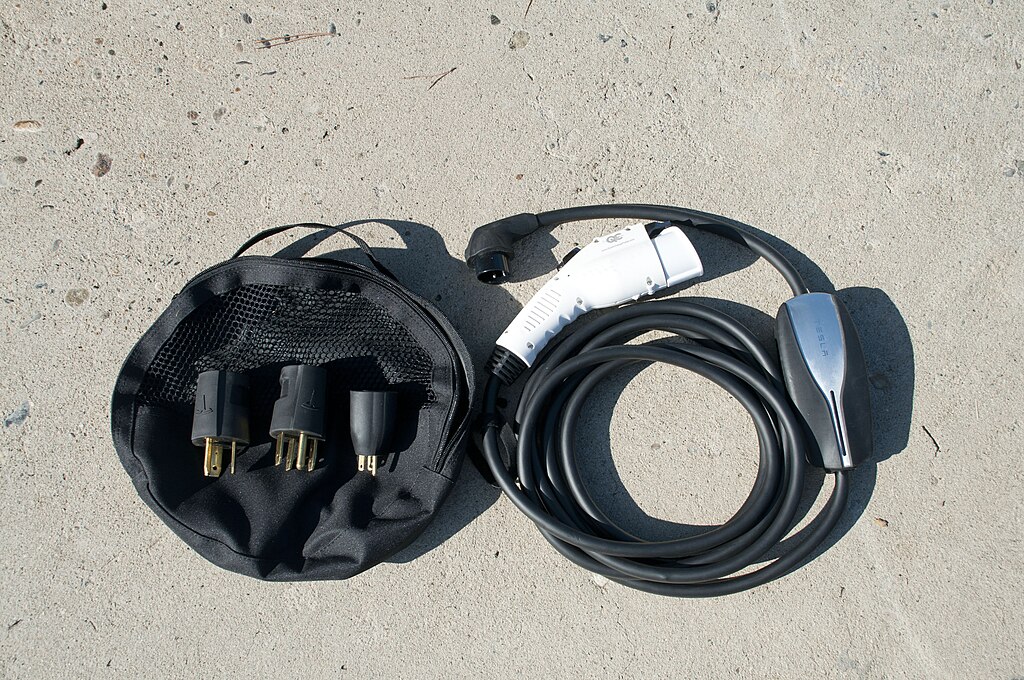
- Renter-Friendly Cord Options: Heavy-duty Level 1 and adjustable 16-amp Level 2 portable cords plug directly into existing garage or dryer outlets without hardwiring.
Drivers covering 13,500 miles annually spend roughly $694 per year when they complete 90% of their charging at home.
Relying exclusively on public DC fast chargers for those same 13,500 miles pushes your yearly energy bill to $2,043.
Over five years of ownership, smart residential charging saves you more than $6,700 compared to public fast-charging stations.
Even if you factor in $1,200 for a residential wall unit and electrician labor, your home setup pays for itself inside 14 months.
💡 Buyer’s Toolkit
Always size your dedicated 240V breaker 25% higher than your charger’s continuous amperage output to satisfy continuous load
rules. Keep a heavy-duty 12-gauge extension cord or NACS J3400 adapter inside a zippered trunk bag for emergency outlet access.
Your home electrical panel dictates how quickly you can replenish your battery pack while you sleep.
A standard 50-amp circuit supports a 40-amp Level 2 charger, adding roughly 30 miles of driving range every single hour.
Most commuters drive fewer than 40 miles daily, meaning your car finishes recharging in under ninety minutes each night.
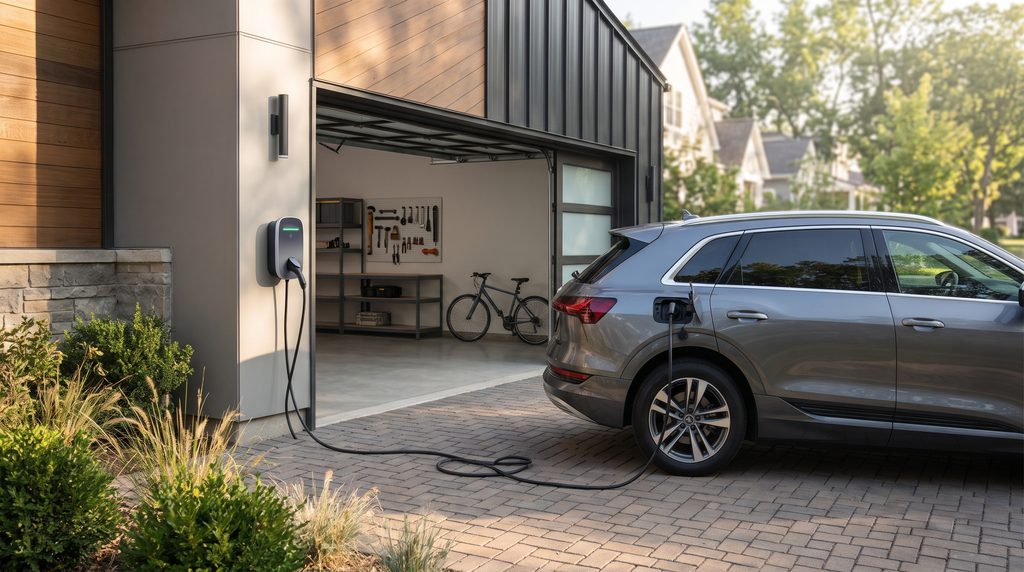
You wake up every morning to a conditioned, ready-to-roll battery without ever detouring to a crowded retail parking lot.
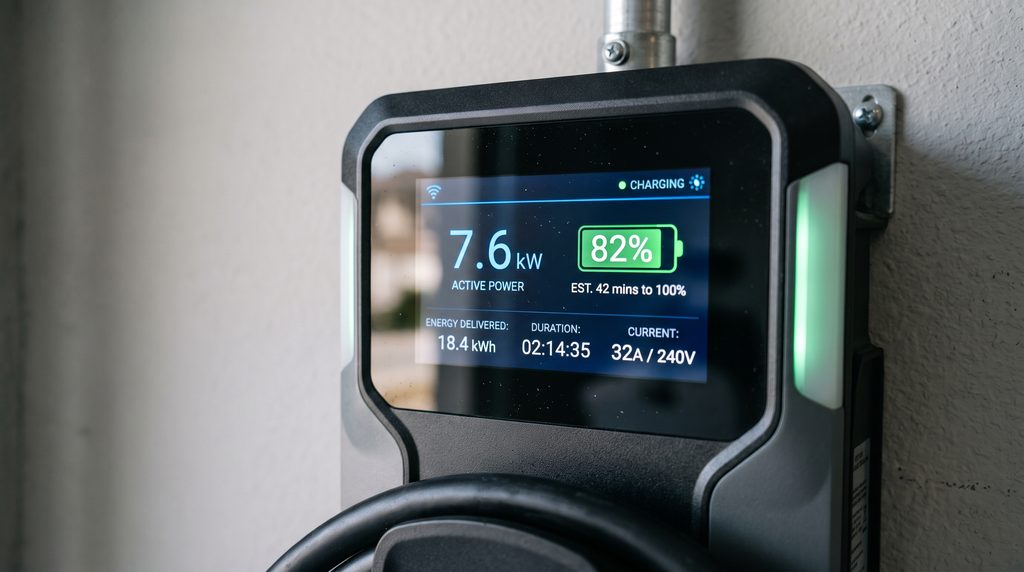
Properly installed home equipment also protects your vehicle’s lithium-ion battery chemistry over a decade of daily driving.
Gentle 9.6 kW alternating current (AC) power generates far less internal cell heat than 250 kW direct current (DC) fast charging.
Every residential installation must follow National Electrical Code NEC Article 625 guidelines to ensure proper grounding and ground-fault protection.
Licensed residential electricians verify your main service panel capacity before mounting a hardwired station or NEMA 14-50 receptacle.
Calculating Your Real Home EV Charging Cost
Your home EV charging cost depends on three measurable variables: your utility rate, your battery size, and charger efficiency.
No charging cable transfers 100% of wall electricity into your battery pack because power conversion creates mild thermal loss.
Level 2 240V stations operate at roughly 90% efficiency, whereas 120V Level 1 trickle cords average closer to 80% efficiency.
To find your exact session cost, multiply your usable kWh added by your utility rate, then divide by 0.90.
Adding 50 kWh to a Ford Mustang Mach-E at $0.18 per kWh requires 55.5 kWh from the wall, costing exactly $10.00.
If you live in states with cheap hydroelectric or wind power like Washington or Texas, your rate drops near $0.14 per kWh.
Homeowners in high-rate states like California or Massachusetts pay $0.30 to $0.34 per kWh on standard residential tiers.
Pairing rooftop solar panels or portable solar generators with your daily routine slashes those high coastal electric bills immediately.
⚡ Safe Installation & Rebate Guide
Check your electric utility’s online rebate portal before hiring an electrician, as many providers offer $250 to 1,000
back on UL-certified chargers. Request three itemized quotes from licensed residential installers to
compare panel load calculations and permit fees.
When Public Fast Charging Prices Make Sense
Public fast charging prices look steep on paper, yet highway DC stations remain essential for stress-free long-distance travel.
According to Q3 2026 network data, national DC fast charging averages $0.54 per kWh across major highway corridors.
Tesla Supercharger locations average $0.40 per kWh for monthly pass members and $0.57 per kWh for non-member drivers.
Networks like Electrify America and EVgo typically charge between $0.48 and $0.64 per kWh depending on local peak electricity demand.
Spending $28 to charge from 10% to 80% in 22 minutes makes total sense when you are 300 miles from home.
You pay a premium for 150 kW to 350 kW ultra-fast hardware that adds 200 miles of highway range during a quick lunch break.
Smart road-trippers also look for hotels offering complimentary Level 2 destination chargers so they start the next morning at 100%.
Avoiding Hidden Public Network Fees
Public networks enforce strict idle fees ranging from $0.40 to $1.00 per minute once your battery reaches its target charge limit.
Always move your vehicle within five minutes of completion to avoid paying more for parking than for actual electricity.
Download network apps like PlugShare and A Better Routeplanner to compare station prices before pulling off the interstate.
Off-Peak Utility Rates And Smart Load Management
Off-peak utility rates let savvy homeowners cut their overnight charging bill in half without changing their driving habits.
Most electric utilities offer special EV Time-of-Use (TOU) plans that slash power costs between 11:00 PM and 6:00 AM.
Instead of paying $0.22 per kWh at 6:00 PM when everyone runs air conditioners, you pay $0.08 to $0.11 overnight.
Smart chargers like the Emporia Classic and Wallbox Pulsar Plus connect to your home Wi-Fi to automate this schedule effortlessly.
You simply plug in when you get home from work, and the charger waits until midnight to draw power.
Solving Older 100-Amp Home Panels
Many older homes have 100-amp main electrical panels that lack headroom for a dedicated 50-amp EV circuit.
Instead of spending $3,500 on a full utility service upgrade, you can install a smart load-balancing charger.
Devices like the Emporia Pro with Vue sensors monitor your home’s real-time power draw at the main breaker.
When your electric dryer or central air turns on, the charger automatically throttles down amperage to prevent an overload.
Once those heavy household appliances cycle off, your EV charger ramps back up to full speed safely.
Apartment EV Charging Solutions For Renters
Apartment EV charging solutions help renters capture low residential electricity rates even without a private single-family garage.
If your assigned carport or garage stall has a standard 120V household outlet, Level 1 charging covers most daily commutes.
Plugging into a 120V outlet adds 4 to 5 miles of range per hour, yielding 45 miles over a 10-hour night.
Always inspect the outlet first to confirm it sits on a dedicated 15-amp or 20-amp circuit without shared space heaters.
Using Portable Power Stations And Balcony Solar
Renters without any garage outlets can pair a high-capacity LFP portable power station with folding solar panels for emergency top-ups.
A 2 kWh unit like the EcoFlow DELTA 2 Max ($1,399) or Anker SOLIX F2000 ($1,299) adds roughly 6 to 8 miles of range.
You simply use a neutral-ground bonding plug so your portable EVSE recognizes a safe ground connection during off-grid charging.
While portable units will not replace a 240V wall box, they provide priceless peace of mind when street parking overnight.
Five-Year Ownership Math: Garage Vs Highway Networks
Comparing five-year fueling totals proves why home vs public charging remains the biggest financial lever in EV ownership.
A driver logging 15,000 miles per year in a mid-size electric SUV averaging 3.2 miles per kWh uses 4,688 kWh annually.
At the national residential average of $0.18 per kWh, five years of home charging costs $4,219 total.
Using off-peak TOU rates at $0.11 per kWh drops your five-year fueling expense to just $2,578.
Public Level 2 stations averaging $0.30 per kWh push that same five-year driving bill up to $7,032.
Relying mostly on $0.54 per kWh DC fast chargers inflates your five-year cost to $12,657.
Even an equivalent 28 MPG gasoline SUV at $4.25 per gallon costs $11,384 over five years of driving.
Charging at home beats both gasoline pumps and public fast-charging networks by more than $7,000 over five years.
Conclusion
Winning the home vs public charging equation starts with treating public fast chargers as road-trip tools rather than your daily fuel pump.
Verify your garage breaker capacity or assigned carport outlet first so you can safely install a UL-certified Level 2 station.
Combining overnight off-peak utility schedules with residential solar slashes your per-mile driving cost below five cents.
Gentle overnight AC charging also keeps your battery pack cool, preserving maximum range and factory warranty protection for years.
Set up your home charging routine today, and enjoy effortless mornings with a full battery waiting in your driveway.