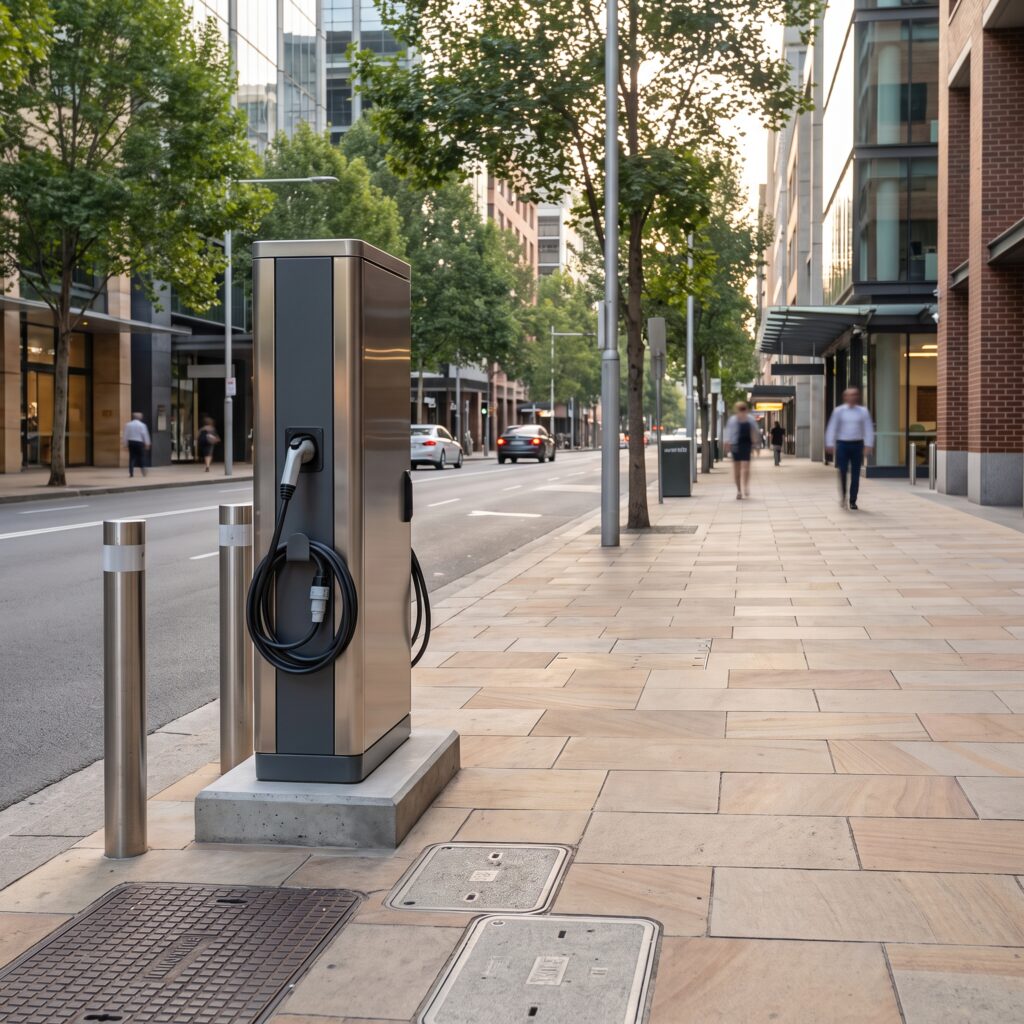
Kerbside EV Charging Design Guide protocols published by Transport for NSW establish clear framework guidelines for public infrastructure installations across local council road reserves to standardize commercial asset deployments while ensuring complete regulatory compliance and optimal structural protection for expanding urban transit networks deployed nationwide…
Disclaimer: This post contains affiliate links. If you click through and make a purchase or submit a request for a quote, we may earn a small commission or referral fee at no extra cost to you.
Table of Contents
Standardizing Deployments via the Kerbside EV Charging Design Guide
The rollout of sustainable transit infrastructure requires strict adherence to standardized structural designs that safeguard long-term public investments.
Transport for NSW released its comprehensive design guidelines in June 2026 to resolve growing spatial and technical inconsistencies across municipal roadside boundaries.
This new framework was produced in close collaboration with the Department of Climate Change, Energy, the Environment and Water to provide definitive rules for councils and charge-point operators.
Prior to this publication, commercial charge-point operators encountered significant friction due to conflicting local engineering codes and fragmented spatial planning requirements.
The document focuses specifically on fixed public infrastructure deployed directly within the verge area of public road reserves.
By implementing strict standardization, the state government aims to reduce initial planning bottlenecks while ensuring that all hardware installations feature structural longevity.
The rapid increase in passenger electric vehicle adoption across Australia necessitates a shift from sporadic charging lots to highly organized, uniform curbside networks.
Local councils operate simultaneously as planning authorities, roads authorities, and community stewards, making a unified technical reference document absolutely essential for streamlined engineering workflows.
The guide deliberately excludes internal electrical grid grid-connection criteria, which remain under the separate jurisdiction of local distribution network service providers.
Instead, the framework establishes precise physical parameters for integration into diverse street typologies, ensuring pedestrian access and roadside safety are never compromised.
Urban center streets, connector pathways, and established neighborhood zones represent the primary target environments for these public infrastructure rollouts.
Conversely, destination high streets with heavy pedestrian bottlenecks or dedicated bus and cycling lanes are classified as generally unsuitable for fixed curbside hardware.
Project planners must systematically analyze localized foot traffic and sidewalk clearances before selecting specific hardware configurations for deployment.
Proper site selection serves as the first line of defense against operational accidents and premature structural degradation from external urban impacts.
Selecting the correct charging topology requires a deep understanding of local streetscapes and available mounting structures.
The framework identifies five distinct categories of public charging units currently authorized for deployment within the state’s public road reserves.
Pole-mounted charging units represent the least disruptive option, attaching directly to existing timber utility poles within the street verge.
These pole-mounted assets are classified into Level 2 slow configurations delivering 7kW single-phase AC or Level 2 fast configurations delivering 11kW to 22kW three-phase AC.
Pedestal and bowser types comprise standalone charging hardware that requires intensive civil engineering works, including specialized deep-foundation concrete pours.
These standalone pedestal units typically handle higher power thresholds ranging from 22kW up to 75kW DC, making them excellent solutions for short-stay urban parking zones.
Advertising-enabled units introduce integrated digital display screens into the streetscape, subjecting operators to strict regulatory controls regarding luminance levels, animation speeds, and visual impact.
Padmount kiosk units represent an innovative integration method where a 25kW to 50kW DC rapid charger is integrated into a new protective casing wrapped around an existing substation asset.
These kiosk systems are ideally suited for high-density, high-footfall urban environments where maintaining minimum sidewalk clearances is a critical non-negotiable metric.
Technical Specifications and Envelope Integrity
- Wind-Velocity Ratings: Engineering designs must conform to localized wind load requirements up to Region A4 standards to prevent structural failure during extreme atmospheric events.
- Structural Standards: All public road reserve installations must comply fully with the strict spatial clearing mandates of the Disability Discrimination Act alongside AS/NZS 3000 electrical installation rules.
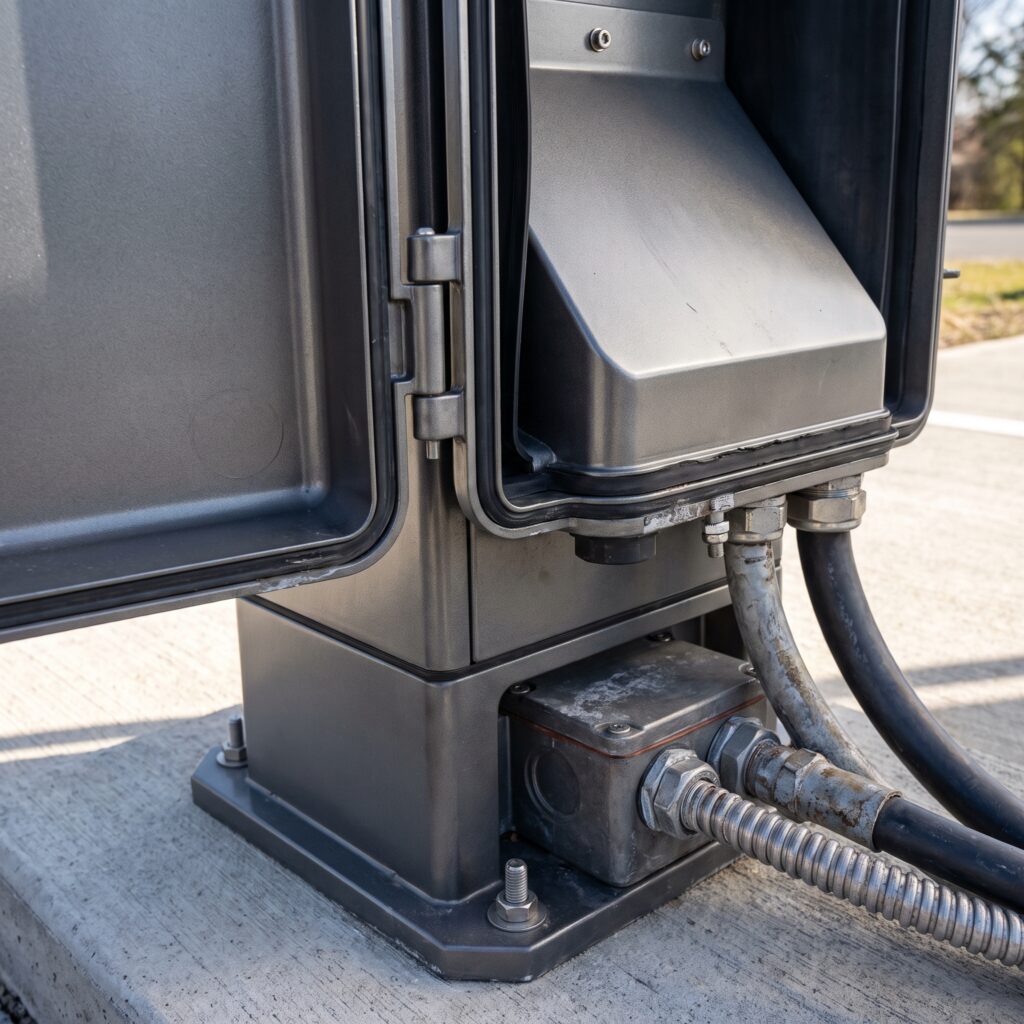
- Envelope Core Components: Utilizing heavy-duty structural insulated panels (SIPs) and precision-engineered metal housings shields sensitive power electronics from moisture ingress, extreme ambient temperatures, and intentional vandalism.
Deploying high-durability enclosures ensures that internal subcomponents maintain optimal thermal thresholds during intense mid-day operating cycles.
Preventative maintenance schedules must be strictly hardcoded into operator service contracts to mitigate the ongoing risks of public hardware wear and tear.
Physical asset exposure to coastal salt spray, intense solar UV radiation, and heavy rainfall requires the use of marine-grade powder coatings on all exterior surfaces.
Regular structural inspections should prioritize checking foundation anchor bolts, verifying conduit seal integrity, and assessing the torque values of critical structural fasteners.
💡 Pro Tip: When installing pedestal-style public charging infrastructure in high-traffic zones, implement heavy-duty polymer-coated steel bollards ahead of the foundation to absorb low-speed vehicular impacts and protect the core structural enclosure from costly structural deformation.
Financial Asset Protection and Capital Expenditure Mitigation
Transitioning public transit networks to electrified models requires massive initial investments that must be protected through strategic long-term risk mitigation.
The state government recently updated the comprehensive NSW Electric Vehicle Strategy, committing over AU$100 million in public funding to accelerate infrastructure rollouts.
A substantial portion of this capital injection is explicitly ring-fenced for heavy vehicle electrification, municipal council grants, and public charging infrastructure expansion.
Commercial operators can leverage these state-backed grants to offset the significant upfront capital costs associated with grid upgrades and structural housing deployments.
However, securing public funding requires operators to demonstrate complete alignment with the engineering principles detailed in the design guide.
Unstandardized installations run the risk of premature obsolescence, elevated insurance premiums, and catastrophic structural failure during severe weather events.
By mandating precision engineering and high-durability building envelopes, councils can effectively drive down their long-term operational expenditures.
Financial Comparison Matrix
- Upfront Capital Expenditure (CapEx): Procurement of premium structural insulated panels, marine-grade anti-corrosive coatings, high-torque structural fasteners, and certified crash-rated protective bollards for site fortification.
- Long-Term Risk Mitigation: Substantial reductions in annual insurance premiums, minimization of localized civil engineering rework, prevention of catastrophic structural weathering, and the elimination of early-lifecycle asset replacement costs.
Integrating robust physical protections during the initial civil construction phase eliminates the need for expensive structural retrofitting later in the asset lifecycle.
Furthermore, standardized hardware configurations allow field service technicians to execute rapid component replacements, dramatically reducing total system downtime.
Maximizing station uptime is critical for achieving positive return-on-investment metrics and maintaining high user satisfaction scores across the public transit network.
Municipalities that prioritize high-quality structural standards protect themselves from sudden liabilities arising from hardware failures in the public domain.
Clear planning approval pathways further optimize the financial viability of these clean energy projects by reducing costly administrative delays.
Under the State Environmental Planning Policy (Transport and Infrastructure) 2021, specific installation types qualify as exempt developments.
For instance, mounting a Level 2 charger onto an existing utility pole that does not carry a transformer can completely bypass lengthy local planning consent loops.
This exempt pathway allows commercial charge-point operators to deploy regional networks rapidly without incurring heavy soft-cost expenditures during the pre-construction phase.
Larger installations executed by public utilities follow rigorous environmental assessment protocols to guarantee zero negative impacts on local ecosystems and public spaces.
Prioritizing installations in older urban sectors urbanized prior to the 1950s ensures that high-density residential zones without private garages gain immediate access to clean energy.
Conclusion
The publication of the Kerbside EV Charging Design Guide marks a monumental shift toward highly organized, resilient, and standardized public charging infrastructure across New South Wales.
By establishing strict spatial parameters, defining clear planning pathways, and mandating heavy-duty engineering standards, the framework safeguards public spaces while accelerating clean energy transition goals.
Commercial developers, urban planners, and local councils must actively integrate these structural directives into their immediate procurement and construction workflows.
Adhering to these precision guidelines minimizes upfront financial risks, lowers long-term operational costs, and protects expensive hardware from physical and environmental degradation.
Ultimately, executing these robust technical blueprints ensures that the expanding transit network remains reliable, safe, and highly functional for decades to come as the Kerbside EV Charging Design Guide shapes future urban mobility.