Vehicle-to-home V2H explained systems allow everyday drivers to power critical household appliances directly from their electric car battery during unexpected blackouts.
Severe winter storms and summer grid failures frequently leave families sitting in the dark without refrigeration, medical equipment, or internet access.
Transforming your parked vehicle into a high-capacity residential power bank provides unmatched emergency resilience without relying on noisy gas generators.
Disclaimer: This post may contain affiliate links. If you click through any of the links in the article and make a purchase or submit a request for an installer quote, we may earn a small commission or referral fee at no extra cost to you.
Table of Contents
Vehicle-To-Home V2H Explained For Emergency Residential Backup Power
Understanding vehicle-to-home V2H explained technology starts with recognizing the massive battery pack already sitting quietly inside your garage.
A typical whole-home stationary wall battery provides between 10 and 13.5 kilowatt-hours of usable electrical storage.
By contrast, modern electric cars house massive battery packs ranging from 60 kilowatt-hours to well over 130 kilowatt-hours.
That colossal capacity holds enough clean electricity to power an average household’s essential circuits for multiple consecutive days.
True vehicle-to-home integration uses specialized bidirectional charging equipment to convert your car battery’s direct current back into alternating current.
During a utility outage, an automated home gateway disconnects your home panel from the grid to prevent dangerous utility backfeeding.
The bidirectional system then seamlessly routes clean power backward through your garage station directly into your household breaker box.
Automakers like Ford with their Intelligent Backup Power and Tesla with Powershare lead the market in offering dedicated residential hardware.
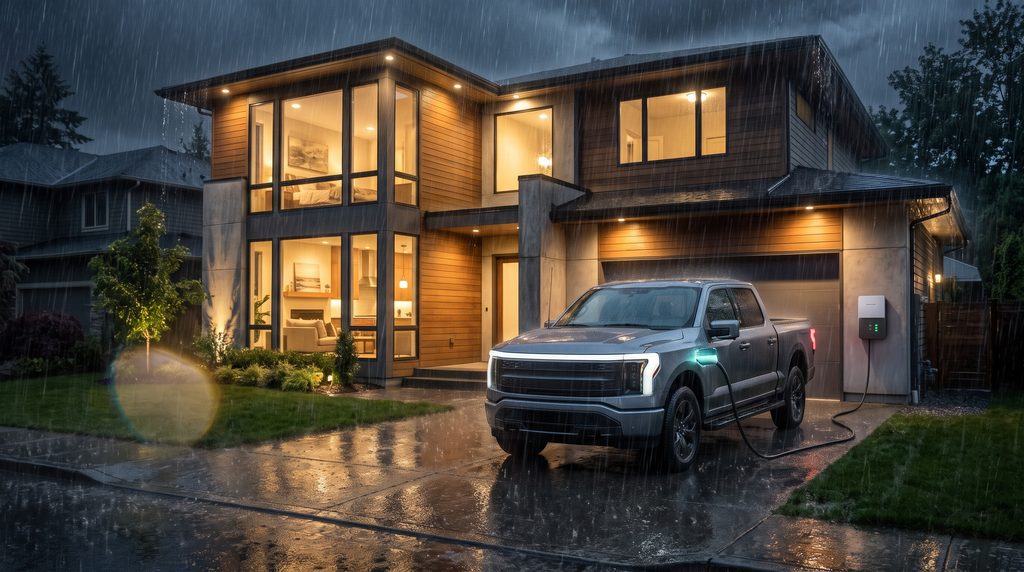
When properly configured, a Ford F-150 Lightning supplies up to 9.6 kilowatts of continuous power to your home panel.
Tesla Powershare systems deliver up to 11.5 kilowatts, which easily runs central heating, refrigeration, and lighting without interruption.
This level of robust power allows suburban families to maintain normal daily living routines while neighborhood power lines remain offline.
Investing in permanent bidirectional charging infrastructure permanently solves severe weather emergencies without requiring ongoing fuel purchases.
💡 Buyer’s Toolkit:
Never connect an electric vehicle’s high-voltage electrical port directly into a standard household wall outlet
without a certified transfer switch. Backfeeding an electrical panel without an automated utility disconnect switch
violates National Electrical Code safety standards and creates severe electrocution hazards for utility line workers
restoring neighborhood power.
The Budget Alternative: Vehicle-To-Load Adapters Versus Whole-Home V2H
While full vehicle-to-home V2H explained setups deliver automated whole-house power, whole-home installation packages frequently cost upwards of $4,000.
Fortunately, budget-conscious drivers and apartment renters can achieve remarkable emergency resilience using simple Vehicle-to-Load adapters.
Vehicles built on 800-volt charging architectures, such as the Hyundai Ioniq 5 and Kia EV6, include built-in bidirectional inverter software.
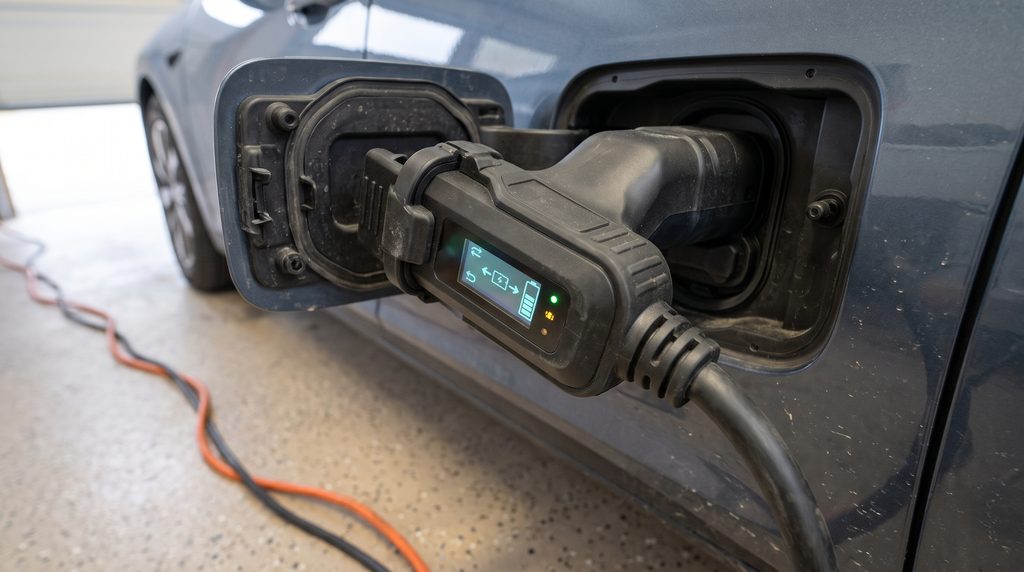
Drivers simply plug a compact $100 V2L adapter directly into the vehicle’s external charging port while parked in their garage.
The external adapter provides a standard 120-volt household receptacle delivering up to 1,900 watts of safe, continuous alternating current.
From that port, you can run a heavy-duty 12 AWG extension cord directly to your kitchen refrigerator, Wi-Fi router, and medical devices.
During prolonged blackout emergencies, keeping a full-size refrigerator cold requires only about 1.5 kilowatt-hours of energy per day.
That means an ordinary 77 kWh electric crossover can run your food refrigeration and emergency lighting for weeks.
Using an external V2L adapter completely eliminates expensive electrical panel modifications, utility inspection permits, and residential contractor fees.
Renters and townhouse dwellers simply stow the lightweight adapter inside their frunk or under-floor cargo compartment when traveling.
If you own a vehicle without factory V2L capabilities, you can pair a portable power station with your home setup.
Brands like EcoFlow, Bluetti, and Anker manufacture high-capacity portable power stations capable of running emergency appliances during grid failures.
These portable lithium iron phosphate units recharge quickly from home wall outlets, vehicle 12-volt sockets, or folding solar blankets.
Combining portable solar generators with basic vehicle charging cords gives budget-conscious families exceptional off-grid security anywhere.
⚡ Deal & Installer Alert:
Ready to protect your home against severe storm blackouts by turning your electric car into an emergency power plant?
Check verified manufacturer discounts on certified bidirectional adapters starting at $89, or submit your zip code to
get free, zero-obligation installation quotes from licensed residential backup power electricians today.
Managing Battery Reserve Thresholds And Solar Power Integration
Operating a vehicle-to-home V2H explained system safely requires setting firm battery preservation limits in your car’s digital control screen.
Most vehicle infotainment systems feature an emergency reserve slider that prevents your car battery from draining completely flat.
Setting your shutoff threshold to 20% or 30% ensures you always retain adequate driving range to handle medical emergencies or mandatory evacuations.
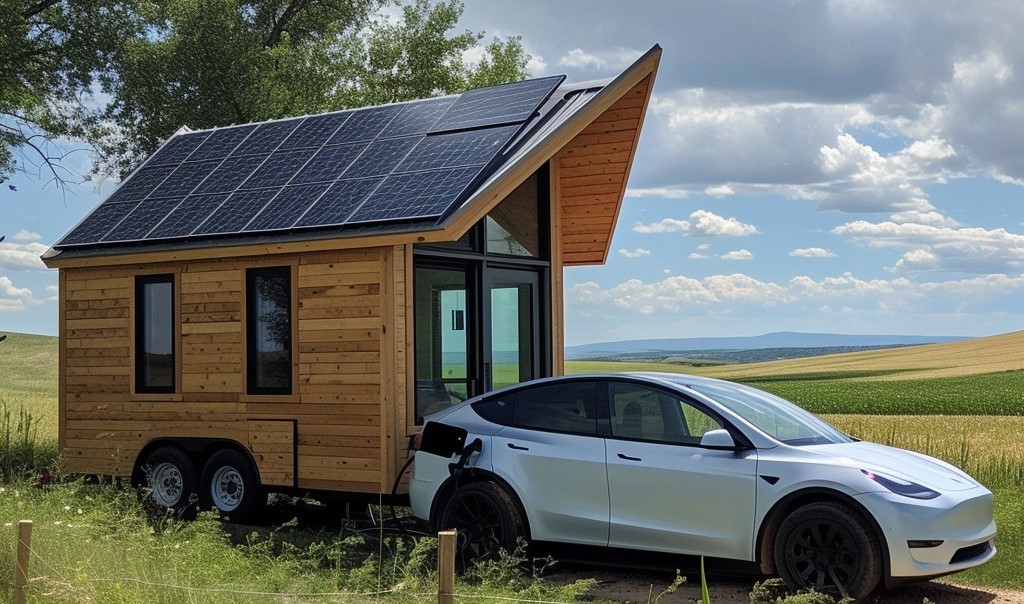
Modern bidirectional home gateways also integrate directly with existing residential rooftop solar panel installations during long outages.
When the sun shines during midday blackout hours, rooftop solar panels recharge your parked electric car through your charging station.
Once the sun sets, your vehicle automatically reverses power flow to keep household refrigerators and lights running smoothly overnight.
This continuous solar microgrid cycle provides indefinite residential power independence during catastrophic storms or extended rural grid failures.
Utilizing moderate continuous discharge rates also keeps battery cell temperatures low, preventing premature wear on expensive automotive packs.
Taking proactive control of your home backup electricity eliminates dependence on noisy, polluting fossil-fuel combustion generators forever.
Adopting smart bidirectional power strategies turns your daily commuter vehicle into the ultimate clean energy asset for your family.
Conclusion
Understanding vehicle-to-home V2H explained capabilities unlocks unmatched emergency energy resilience, convenience, and peace of mind for every electric car owner.
Always hire a licensed residential electrician to install an approved transfer switch before connecting high-output backup hardware to your home panel.
Pairing your bidirectional vehicle setup with rooftop solar panels or portable solar blankets guarantees sustainable power during prolonged utility outages.
Maintaining an emergency reserve threshold of at least 20% protects high-voltage battery health while preserving immediate driving range.
Transforming your electric vehicle into a silent residential generator delivers absolute clean energy freedom whenever disaster strikes.